
News
English Premier League to Launch Premier League+ Streaming Service in Singapore


The English Premier League will launch its own streaming platform in Singapore this year.
This bold move signals a major shift in its global media strategy.
Premier League chief executive Richard Masters confirmed the news at the Financial Times Business of Football conference.
Moreover, he revealed that the new service, Premier League+, will debut for the 2026/27 season.
For the first time, the league will go direct-to-consumer in Singapore. As a result, fans will subscribe directly through the official platform.
Strategic Partnership With StarHub Strengthens Market Presence
The Premier League has entered into a six-year partnership agreement with StarHub.
Therefore, the Singapore-based telecommunications company will support the rollout of the new platform.
This partnership ensures local expertise and stable distribution. At the same time, it allows the league to manage its own subscriber relationships.
StarHub confirmed that Premier League+ will complement its current coverage. However, existing Premier League packages will remain unchanged.
Fans will continue enjoying live matches through StarHub as usual. Meanwhile, the new streaming option will enhance flexibility and viewing choices.
380 Matches and Exclusive Content on a Dedicated App
Premier League+ will offer access to all 380 matches each season. Additionally, subscribers will enjoy exclusive shoulder programming and in-depth analysis.
The platform will feature a 24/7 dedicated Premier League channel. Consequently, supporters can stay connected beyond matchdays.
Users will download the app on smart TVs or laptops. Thus, streaming becomes seamless and accessible across devices.
This direct digital model reduces reliance on traditional broadcasters. Nevertheless, partnerships with networks like Sky Sports in the UK will continue.
A Blueprint for Global Expansion
Singapore will serve as a testing ground for the league’s streaming ambitions. If successful, the model may expand into other international markets.
Masters described the initiative as a carefully considered process. Furthermore, he emphasized the importance of controlling promotion and pricing strategies.
By owning customer relationships, the league gains valuable market insights. As a result, it can refine engagement strategies and tailor future offerings.
This step also provides commercial optionality in selected regions. Therefore, the Premier League strengthens its long-term media flexibility.
What Singapore Fans Can Expect Next
The service is expected to launch from August 2026. However, final pricing details have not yet been announced.
StarHub confirmed close collaboration with the league during this trial phase. Meanwhile, preparations continue to ensure a smooth rollout.
Singaporean fans will soon experience a new era of football streaming. Above all, Premier League+ promises convenience, exclusivity, and full-season access.
The English Premier League continues to evolve its global footprint. Now, with Premier League+, it takes direct control of its digital future.

In a subtle yet potentially transformative move, WhatsApp is venturing beyond its traditional account bound ecosystem by cultivating a feature known as guest chats. After simmering in Android beta environments for several months, this experimental function is now tiptoeing into iOS and web based testing grounds.
A Controlled Rollout with Expanding Reach
Whispers from beta channels suggest that a select circle of users particularly those navigating iOS via TestFlight and participants in the web beta are beginning to encounter this novel capability. Initially glimpsed in Android trials last August, guest chats signal a deliberate attempt to dissolve one of the platform’s long standing barriers, mandatory account creation.
How Guest Chats Unfold
Rather than forcing newcomers through the usual sign up labyrinth, WhatsApp now permits existing users to conjure a unique invitation link from the “Invite a friend” portal. This link, once dispatched through SMS or third-party apps, opens a gateway into a browser-based chat session.
Upon entry, the guest is assigned a distinctive identifier, which plays a pivotal role in generating encryption credentials. The result? A conversation shielded by end-to-end encryption opaque to WhatsApp itself and visible only to the participants engaged within it.
A One Sided Initiation
Interestingly, the conversational spark must be ignited by the guest. The invited individual must click the link, consent to WhatsApp’s terms, input a display name, and actively commence the dialogue. This design ensures that participation is intentional rather than accidental.
However, there’s a caveat, the invitation link functions like an open door. Anyone in possession of it may step inside, which introduces both convenience and a subtle layer of risk.
Identity, Transparency, and Subtle Persuasion
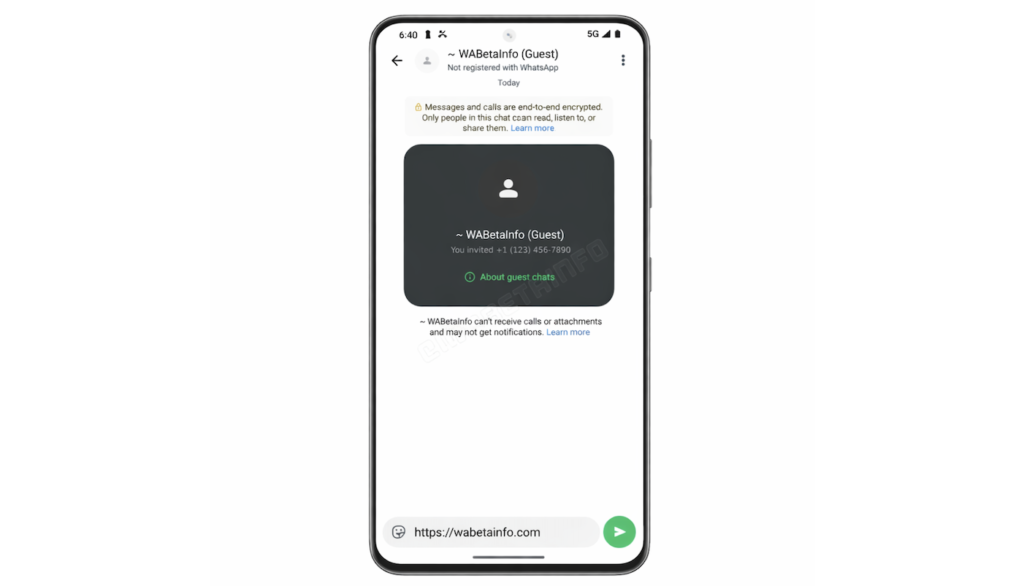
Once inside the chat, guest participants are distinctly marked. Their names bear a “(Guest)” suffix, accompanied by a gentle disclaimer noting their unregistered status. While this transparency maintains clarity, it also serves a quieter purpose nudging guests toward eventual account creation.
This strategic undercurrent may be particularly relevant in regions like the United States, where WhatsApp’s dominance has yet to fully crystallize.
Limitations That Keep It in Check
Despite its intriguing promise, guest chats remain somewhat skeletal in functionality. At present, users should not expect:
- Group conversations
- Voice notes or media attachments
- Stickers, GIFs, or expressive add-ons
- Voice or video calling
Additionally, these chats are not immortal. A period of 10 days of inactivity will quietly dissolve the session, ensuring the feature remains ephemeral rather than permanent.
The Road Ahead
For now, guest chats inhabit a carefully gated environment, accessible only to a limited cohort across iOS, Android, and web platforms. WhatsApp has yet to unveil a definitive timeline for broader availability, leaving observers to speculate on its eventual trajectory.
Yet, even in its infancy, this feature hints at a philosophical pivot one that favors accessibility over exclusivity, and spontaneity over structure. Whether it reshapes user behavior or simply complements existing habits remains to be seen, but its intent is unmistakable, conversation, unencumbered.
Read Also: WhatsApp is gearing up to introduce a highly anticipated feature: scheduled messages
This new functionality will allow users to compose messages and set a specific date and time for automatic delivery, enhancing convenience and communication efficiency. The feature is currently under development by WhatsApp’s parent company, Meta, and has been highlighted by WABetaInfo, a trusted source for WhatsApp updates.
Scheduled messaging is already popular on platforms like Telegram, and Apple’s Messages app has offered a similar “Send Later” option since iOS 18. WhatsApp users have long awaited this capability, as it enables better planning for sending messages without the need for manual intervention at the moment of delivery.
Although the feature is not yet active in the latest WhatsApp beta available on TestFlight, teasers suggest it will be integrated seamlessly. An image shared by WABetaInfo reveals a new “Scheduled Messages” section within group chat info pages. This section will allow users to track the number of messages they have queued and manage their scheduled communications easily. Importantly, the feature is expected to support both individual and group chats, broadening its usefulness.
Currently, WhatsApp users who want to schedule messages must rely on workarounds such as Apple’s Shortcuts app, which is less intuitive and limits accessibility. The upcoming native scheduling tool will simplify the process, making it more user-friendly and efficient.
This development represents a significant upgrade to WhatsApp’s messaging capabilities, addressing one of the platform’s most requested features. Once launched, scheduled messages will empower users to organize their conversations better, ensure timely communication, and reduce the risk of forgetting to send important messages. As WhatsApp continues to evolve, this enhancement is sure to be well received by millions worldwide who rely on the app daily for personal and professional communication.
Xiaomi is preparing a major software reveal at Mobile World Congress in Barcelona. The company plans to launch HyperOS 3.1 alongside the Xiaomi 17 series.
The biggest highlight is the rumored “iOS Bridge.” This feature aims to improve integration between Xiaomi devices and products from Apple. As a result, users may experience smoother cross-platform connectivity.
One standout capability includes real time iPhone call alerts. Incoming calls on an iPhone could instantly appear on connected Xiaomi tablets and laptops. Therefore, users may answer or manage calls without holding their phones.
This feature would simplify multitasking. Moreover, it would create a more unified digital workflow for mixed-device users.
The update is also expected to enhance compatibility with AirPods. Xiaomi devices may display real-time battery levels for AirPods. In addition, users could access advanced controls similar to native Apple integration.
Consequently, switching between ecosystems would feel seamless. This improvement would especially benefit professionals who rely on both brands daily.
Another key addition involves direct wireless file sharing. Xiaomi’s iOS Bridge may allow fast file transfers between iPhones and Xiaomi devices. Importantly, users would not need third-party applications.
Instead, file sharing could become instant and secure. As a result, productivity would increase across devices. Furthermore, users could reduce reliance on cloud storage platforms.
Xiaomi continues to expand its global presence. In 2025, it secured a 16% share of Europe’s smartphone market, according to Omdia. Therefore, strengthening Apple compatibility supports its competitive strategy.
Many consumers use devices from both ecosystems. Consequently, improved cross-platform support increases brand loyalty.
If unveiled between March 2 and March 5 at MWC, this update could redefine device interaction. Ultimately, Xiaomi’s iOS Bridge signals a new era of flexible and connected digital experiences.


Safe Singapore Stocks for Long-Term Investing: Build a Stable Wealth Portfolio

7 Smart Business Optimization Strategies Driving Singapore Digital Economy

AI-Driven Business Intelligence: Transforming Enterprise Strategy in Singapore
Wedding day horror: Groom falls to death at VOCO Orchard Hotel on Wedding Day

EdTech in Singapore: 150+ Companies Driving $180M Digital Learning Revolution

Singapore JC Ranking: A Complete Guide for Students
-
Blog12 months ago
Wedding day horror: Groom falls to death at VOCO Orchard Hotel on Wedding Day
-
Technology11 months ago
EdTech in Singapore: 150+ Companies Driving $180M Digital Learning Revolution
-
Education1 year ago
Singapore JC Ranking: A Complete Guide for Students
-

 Food10 months ago
Yi Dian Dian Bubble Tea Singapore: Menu, Outlets & Try Drinks
-
 Blog1 year ago
Best of SG with Singapore Rediscover Voucher
-
 Business1 year ago
What to Expect During PSLE Marking Days 2023
-
 Digital Marketing10 months ago
How to Run Effective Xiaohongshu Advertising Campaigns
-
 Digital Marketing10 months ago
Why Xiaohongshu Ads Are a Must for Reaching Chinese Consumers