
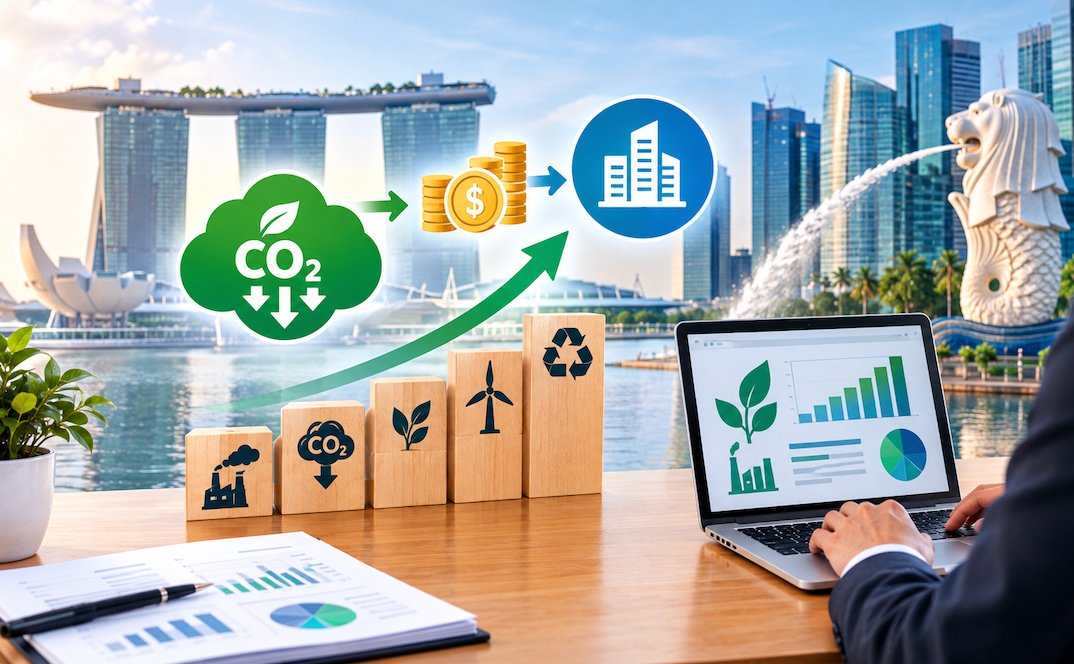
When Singapore’s carbon tax rose to $25 per tonne of greenhouse gas emissions in 2024, up from the $5 rate that had applied since the tax’s introduction in 2019, companies operating oil refineries in Jurong Island and petrochemical plants along the western industrial corridor faced a materially steeper cost curve for their emissions, with the rate scheduled to climb further toward $50 to $80 per tonne by 2030 under the framework administered by the National Environment Agency.
For businesses that had treated the earlier, lower rate as a manageable line item, the jump forced a reassessment of how seriously to invest in emissions reduction versus simply absorbing higher costs.
How Singapore’s Carbon Tax Framework Operates
The tax applies to facilities emitting at or above a threshold of direct greenhouse gas emissions annually, capturing large industrial emitters such as power generation companies, petrochemical facilities, and semiconductor manufacturers with energy-intensive processes, rather than applying broadly across every business in the economy.
Covered entities must measure and report their emissions according to NEA-approved methodologies and purchase carbon credits, formerly through a fixed-price mechanism and now increasingly through a carbon credit trading and offsetting system that allows limited use of high-quality international carbon credits to offset a portion of tax liability.
The staged rate increases were designed deliberately, giving affected companies a multi-year runway to plan capital investment in emissions-reducing technology rather than facing a sudden cost shock.
NEA has also allowed the use of eligible international carbon credits, subject to quality criteria aligned with Article 6 of the Paris Agreement, to offset up to a defined percentage of a company’s taxable emissions, giving businesses some flexibility in how they manage compliance costs alongside direct emissions reduction efforts.
NEA also publishes detailed reporting guidelines specifying which greenhouse gases count toward a facility’s taxable emissions, covering not just carbon dioxide but also methane, nitrous oxide, and several industrial gases with higher warming potential, each converted into a carbon dioxide equivalent figure for tax calculation purposes.
Companies must engage independent verifiers to audit their emissions reports before submission, adding a compliance cost layer on top of the tax itself, though this verification requirement also gives the scheme credibility with international observers who might otherwise question the accuracy of self-reported emissions data from covered facilities.
Which Businesses and Sectors Feel the Direct Impact
Energy-intensive sectors concentrated on Jurong Island, including refining, petrochemicals, and specialty chemicals, bear the most direct exposure given the scale of their emissions relative to output.
Semiconductor manufacturing, a sector Singapore has actively courted as part of its high-value manufacturing strategy, also faces meaningful compliance costs given the energy demands of fabrication processes, creating a tension between climate policy goals and industrial policy ambitions to grow advanced manufacturing employment.
Data centers, while not always classified among the traditionally heaviest emitters, have also drawn regulatory attention given their substantial electricity consumption and the resulting indirect emissions tied to grid power generation.
Singapore had previously placed a moratorium on new data center capacity partly over energy and land use concerns, and the eventual lifting of that pause came with sustainability conditions attached, including efficiency benchmarks that connect indirectly to the broader carbon pricing framework by pushing operators toward lower-carbon power sourcing arrangements such as renewable energy certificates or direct power purchase agreements with solar providers.
Power generation companies pass a portion of carbon tax costs through to electricity tariffs, meaning businesses and households outside the directly taxed sectors still feel the policy’s effects indirectly through utility bills.
This pass-through mechanism means that while the tax formally targets a relatively narrow set of large emitters, its economic reach extends across the broader economy through the electricity price channel, affecting cost structures for businesses ranging from data centers to manufacturing operations that consume grid electricity rather than generating their own power.
Business Strategies for Managing Carbon Costs
Large emitters have responded through a mix of efficiency investments, fuel switching, and in some cases exploring carbon capture technology, though the latter remains at an early stage of commercial deployment in Singapore’s industrial context.
Refineries have invested in process optimization to reduce flaring and improve energy recovery, while some companies have begun exploring hydrogen and ammonia as lower-carbon fuel alternatives for specific industrial processes, motivated partly by the rising cost trajectory of the domestic carbon tax and partly by pressure from international customers demanding lower-carbon supply chains.
Some companies have pursued joint ventures or research partnerships with technology providers specializing in carbon capture, utilization, and storage, an approach still in relatively early commercial stages globally but one that Jurong Island operators have begun piloting at a small scale, given the cluster’s concentration of point-source emissions that could theoretically make collective capture infrastructure more economical than each facility pursuing separate, smaller-scale solutions independently.
Whether such shared infrastructure investment materializes at meaningful scale will depend heavily on future cost reductions in capture technology and continued policy support for early movers willing to bear higher initial costs.
Smaller and mid-sized businesses not directly covered by the tax have nonetheless begun incorporating carbon cost considerations into supply chain decisions, in particular those exporting to markets like the European Union that impose their own carbon border adjustment mechanisms on imported goods with high embedded emissions.
This has created a knock-on effect where even businesses outside the direct tax net face pressure to measure and reduce their carbon footprint to remain competitive in carbon-conscious export markets.
Trade associations representing small and medium enterprises have responded by developing simplified carbon accounting tools and training programs, recognizing that many smaller businesses lack the in-house expertise to conduct a full greenhouse gas inventory on their own.
Enterprise Singapore has supported some of these initiatives through grant funding, reflecting a broader government view that carbon literacy across the wider business community, not just among the largest directly taxed emitters, will matter increasingly as international trade partners tighten their own climate-related import requirements over the coming years.
Economic Trade-Offs and Competitiveness Concerns
Industry groups representing energy-intensive sectors have periodically raised concerns that a rising carbon tax could erode Singapore’s competitiveness relative to jurisdictions with lower or no equivalent carbon pricing, potentially encouraging investment to shift toward regional alternatives without comparable climate policies.
The government has responded partly through the Jurong Island transformation initiatives aimed at supporting decarbonization investment in the chemicals cluster, alongside transitional support measures designed to cushion the adjustment for affected industries during the steepest years of the rate increase.
There is an inherent tension embedded in the policy between climate ambition and industrial competitiveness, and Singapore’s approach has tried to manage this through a gradual rate trajectory rather than an abrupt jump to the eventual target rate.
Economists differ on whether the current pace of increase is fast enough to drive the emissions reductions needed to meet Singapore’s climate commitments, or whether the emphasis on protecting competitiveness has slowed the transition more than climate advocates would prefer.
Labor unions representing workers in energy-intensive sectors have raised a parallel concern about job security, noting that any acceleration in decarbonization investment or, in a worst case, plant closures driven by carbon costs could displace workers with specialized skills not easily transferable to other industries.
The government has responded by linking parts of its Jurong Island transformation support to workforce transition planning, requiring companies receiving transitional assistance to demonstrate how they intend to retrain or redeploy affected workers rather than treating decarbonization purely as a technical and financial exercise disconnected from its workforce implications.
Comparing Singapore’s Carbon Pricing to Other Jurisdictions
Singapore’s carbon tax rate remains lower than the European Union’s Emissions Trading System price, which has at various points traded well above $80 per tonne equivalent, though direct comparisons are complicated by differences in scheme design, sector coverage, and the availability of offset mechanisms.
The European Union’s parallel introduction of a carbon border adjustment mechanism, which imposes a carbon cost on imports based on their embedded emissions, has added pressure on Singapore-based exporters to demonstrate credible decarbonization progress regardless of the domestic tax rate, since failing to do so risks facing equivalent charges at the EU border instead.
Japan and South Korea have each pursued carbon pricing mechanisms with their own distinct designs, Japan through a more gradual, lower-rate approach historically criticized by climate advocates as insufficiently ambitious, and South Korea through an emissions trading scheme covering a broad swath of its industrial base.
These varied regional approaches mean multinational companies operating across several Asian markets often face a patchwork of different carbon pricing rules, adding a layer of compliance complexity that has pushed some firms to adopt an internal carbon price well above any single jurisdiction’s actual rate, using that higher internal benchmark to guide investment decisions in a way that anticipates future regulatory tightening across all their markets of operation.
Regional coordination on carbon pricing standards, while still at an early stage, has been discussed within ASEAN policy circles as a way to reduce this fragmentation, though political and economic differences among member states make a unified regional carbon price an unlikely prospect in the near term.
Within the Southeast Asian region, Singapore was an early mover in adopting carbon pricing, ahead of most neighboring economies, which has positioned the city-state as something of a regional reference point for how a carbon tax framework might be designed and phased in. Malaysia and Indonesia have
both explored carbon pricing mechanisms of their own, with some policymakers in the region citing Singapore’s staged implementation approach as an informative case study for managing the transition without triggering sudden competitiveness shocks.
Vietnam and the Philippines have both signaled intentions to explore carbon pricing mechanisms of their own in coming years, and delegations from several regional environment ministries have visited Singapore specifically to study how NEA structured its phased rate increases and offset eligibility rules before designing comparable frameworks suited to their own industrial bases.
Future Trajectory of Carbon Pricing Policy
NEA has signaled the intended rate range through 2030, giving businesses a reasonably clear planning horizon, though the exact pace of increases within that range and the framework’s evolution
beyond 2030 remain subject to review based on international climate negotiations and domestic economic conditions. Expect continued refinement of the international carbon credit eligibility criteria, as global standards for high-quality offsets continue to evolve following criticism of some earlier voluntary carbon markets for weak verification standards.
Singapore has also pursued bilateral agreements with other countries under the Paris Agreement’s Article 6 framework, establishing structured cooperation on generating and trading carbon credits that meet the higher integrity standards these agreements require.
Such arrangements give Singapore-based companies a more reliable and better-governed supply of offset credits than the broader voluntary carbon market has historically offered, and continued expansion of these bilateral partnerships is likely as demand for credible offsets grows alongside the rising domestic tax rate.
Further integration between carbon tax policy and other decarbonization tools, including Green Mark building standards and incentives for renewable energy procurement, is also likely as Singapore works toward its broader net-zero by 2050 commitment.
Businesses should expect the direction of travel to remain firmly toward higher carbon costs over time, even if the specific pace of increases beyond the currently announced trajectory remains subject to periodic government review.
Practical Guidance for Affected Businesses
Companies directly covered by the tax should conduct detailed emissions audits to identify the most cost-effective reduction opportunities before defaulting to reliance on carbon credits, since credit prices and availability may tighten as more jurisdictions implement similar carbon pricing schemes and demand for high-quality offsets grows globally.
Building internal capability to track emissions accurately, rather than treating reporting as a purely compliance-driven exercise, tends to pay off as disclosure expectations from investors and customers continue to rise.
Businesses in supply chains connected to carbon-taxed sectors, even if not directly covered themselves, should begin measuring their own carbon footprint proactively, especially if they export to markets with carbon border adjustment mechanisms.
Engaging early with NEA guidance and industry association resources on decarbonization pathways can help businesses of all sizes plan capital investment decisions around a cost trajectory that is very likely to keep rising over the coming years.
Finance teams should also model multiple future carbon price scenarios rather than a single fixed assumption when evaluating long-lived capital projects, since equipment or facility investments made today will likely operate through several further rounds of carbon tax increases before reaching the end of their useful life.
Final Thoughts
Singapore’s carbon tax has evolved from a modest, largely symbolic $5 per tonne rate into a serious cost factor for the country’s energy-intensive industries, with a clear trajectory toward $50 to $80 per tonne by 2030.
The policy tries to balance climate commitments against industrial competitiveness through gradual, telegraphed rate increases rather than sudden shocks, though tensions between these two goals persist.
Businesses across the economy, whether directly taxed or connected through supply chains and electricity pricing, will need to treat carbon costs as a permanent and rising feature of doing business in Singapore going forward.
The companies that adapt earliest, rather than those that wait for the rate trajectory to force their hand, are likely to be the ones that turn a compliance obligation into a lasting operational advantage.
Frequently Asked Questions
Which companies are required to pay Singapore’s carbon tax?
The tax applies to facilities that emit greenhouse gases above a specified annual threshold, primarily covering large industrial emitters such as power generation, petrochemical, and semiconductor manufacturing facilities.
Smaller businesses below the threshold are not directly liable, though they may feel indirect effects through electricity prices.
How high will Singapore’s carbon tax eventually go?
The government has signaled an intended range of $50 to $80 per tonne by 2030, following the increase to $25 per tonne in 2024.
The exact pace beyond that range will depend on future policy review and international climate developments.
Can businesses use carbon credits to reduce their tax liability?
Yes, NEA allows eligible high-quality international carbon credits to offset a limited percentage of a covered company’s taxable emissions, subject to specific quality and verification criteria aligned with international standards under the Paris Agreement framework.
Does the carbon tax affect household electricity bills?
Indirectly, yes. Power generation companies subject to the tax may pass through a portion of the added cost to electricity tariffs, meaning households and businesses that are not directly taxed can still see modestly higher utility costs over time as the tax rate rises.
How does Singapore’s carbon tax compare with the European Union’s carbon pricing?
Singapore’s tax rate has generally remained lower than prices seen in the EU Emissions Trading System, though comparisons are complicated by differing scheme designs.
The EU’s carbon border adjustment mechanism adds separate pressure on Singapore exporters regardless of the domestic tax rate.
What support is available for businesses affected by rising carbon costs?
The government has introduced transitional support measures and initiatives tied to the Jurong Island transformation program to help energy-intensive industries invest in decarbonization technology.
Affected businesses should consult NEA and relevant industry associations for current support scheme details.