
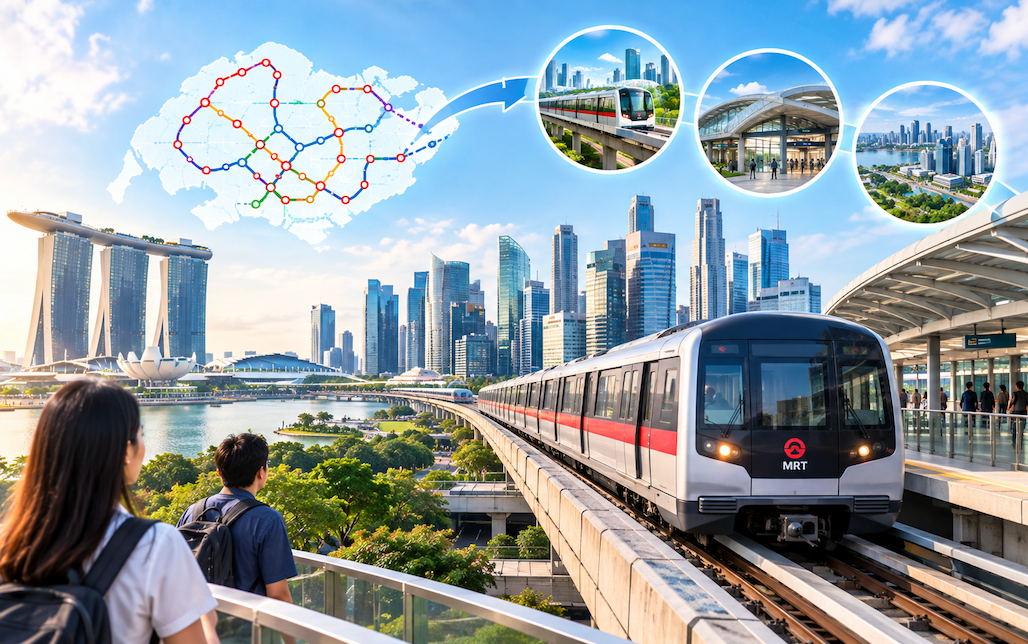
Commuters boarding at Woodlands North station in 2019 became the first riders on a Thomson-East Coast Line segment that would eventually stretch across the island, connecting the northern woodlands to the eastern coast by the time the full line completes in stages through the mid-2020s.
That single line, alongside the Jurong Region Line slated to open progressively from 2027 and the Cross Island Line targeted for its first phase around 2030, forms the backbone of what the Land Transport Authority describes as a rail network set to double in length from its early-2010s size.
For residents in previously underserved areas like Punggol, Tengah, and the western industrial belt around Jurong, these projects are not abstract infrastructure announcements they determine property values, commute times, and where new town planning concentrates housing and jobs.
How the Current Expansion Fits Together
The Thomson-East Coast Line runs roughly north to south and then curves along the eastern coastline, intersecting with existing lines at multiple interchange stations to spread commuter load more evenly across the network. The Jurong Region Line targets the western part of the island, an area historically underserved by rail despite housing substantial residential population and the Jurong Innovation District’s growing employment base.
The Cross Island Line, meanwhile, is designed as an orbital route connecting the eastern and western halves of the island without requiring a transfer through the congested city center, a design choice intended to relieve pressure on the North-South and East-West lines.
Each of these lines was planned with future extensions already sketched into land-use plans, meaning stations are often built with provisions for later connections even before ridership justifies immediate expansion.
This forward-loaded planning approach reflects a broader LTA strategy of reserving rail corridors decades in advance, sometimes before residential development in a given area has even begun, which explains why new towns like Tengah were designed around a rail line’s future alignment rather than retrofitting transit into an already-built town.
Interchange design has also become more sophisticated across this expansion cycle, with stations increasingly built to allow cross-platform transfers or short walking connections between lines rather than requiring commuters to exit fare gates and re-enter a separate station.
Sungei Bedok, planned as a future interchange between the Thomson-East Coast Line and a later extension of the Downtown Line, illustrates this approach, with the station’s structure accommodating a connection that will only be completed years after the station itself opens, another example of LTA building physical capacity ahead of confirmed demand rather than waiting until a connecting line is fully committed.
Who Benefits Most from the New Lines
Residents in new towns built around the expansion, including Tengah, Punggol, and parts of the Jurong Region Line corridor, gain the most direct benefit through shorter commutes to the central business district and reduced reliance on buses or private vehicles.
Property developers in these areas have already factored future MRT access into launch pricing, with units near planned but unopened stations often commanding a premium compared to otherwise similar developments further from a station.
Businesses located along new interchange stations, not least retail and food and beverage operators, stand to benefit from increased footfall once stations open, a pattern well documented from earlier line openings such as the Downtown Line, where commercial rents near new stations rose measurably in the years following opening.
Employers with campuses in areas like the Jurong Innovation District or Punggol Digital District also benefit from improved talent access, since a wider labor pool becomes willing to consider a commute that a rail connection makes practical.
Older residents and those with mobility challenges also stand to gain, since newer stations are built with barrier-free access as standard rather than retrofitted after the fact, a design principle that has become more consistent across the network compared to some older stations built decades ago under different accessibility standards.
Schools, hospitals, and other public institutions located along new rail corridors likewise benefit from improved accessibility, which planners factor into decisions about where to locate new schools or expand hospital capacity, recognizing that transport access shapes catchment areas for essential public services just as much as it shapes commercial activity.
Economic and Property Market Implications
Rail connectivity has historically been one of the more reliable predictors of residential property appreciation in Singapore, and the current expansion cycle is widely expected to follow that pattern.
Analysts tracking resale transaction data have observed that HDB flats and private condominiums near newly announced or newly opened MRT stations tend to see price appreciation ahead of the broader market in the years surrounding a station’s confirmation and opening, a dynamic sometimes referred to informally as the “MRT premium.”
This effect tends to be most pronounced in the period between a line’s formal confirmation and its actual opening, since buyers and investors price in the anticipated benefit early while uncertainty about exact station locations and opening dates still leaves room for further appreciation once construction milestones are hit and the eventual commute time savings become concrete rather than speculative.
Beyond residential property, the expansion supports Singapore’s broader decentralization strategy, spreading commercial activity away from the traditional central business district toward regional centers such as Jurong Lake District, which the government has designated as a second central business district.
This decentralization reduces peak-hour congestion pressure on the city center while distributing economic activity more evenly across the island, a goal that has featured in Singapore’s land-use planning since the Concept Plan framework was first articulated decades ago.
Retail rents near confirmed but unopened stations have shown a pattern of gradual appreciation as opening dates approach, with landlords adjusting asking rents upward well before actual footfall increases materialize, a dynamic that reflects forward-looking pricing by commercial landlords rather than a reaction to already-realized demand.
This anticipatory pricing behavior means businesses signing leases near future stations should expect rent negotiations to already reflect a portion of the eventual connectivity benefit, rather than assuming they can capture the full upside of improved access at today’s pre-opening rental rates.
Construction Challenges and Trade-Offs
Building new rail lines beneath one of the world’s most densely built urban environments carries engineering challenges that go beyond simple tunneling. Contractors have had to navigate existing utility networks, building foundations, and in some cases historically sensitive sites, all while minimizing disruption to surface-level traffic and business operations.
Construction near existing MRT lines requires careful vibration and settlement monitoring to avoid affecting live rail operations, adding both cost and schedule complexity to projects that already span a decade or more from planning to completion.
Local businesses along construction corridors have at times reported reduced footfall during multi-year construction phases, a trade-off that LTA and the Singapore Land Authority have tried to mitigate through compensation schemes and construction period management, though affected shopkeepers have periodically voiced frustration over the length of disruption relative to the compensation offered.
Ground conditions across Singapore vary widely, with some tunnel sections passing through soft marine clay that requires more intensive ground treatment than the harder rock formations found elsewhere on the island, adding engineering complexity that is not uniform across the network.
Contractors have had to adapt tunneling methods station by station based on these varying geological conditions, and unexpected ground conditions discovered mid-construction have occasionally required design adjustments that add both time and cost to individual project segments, a risk factor that is difficult to fully price into initial project budgets no matter how thorough preliminary soil surveys have been.
Budget overruns and schedule delays have also featured in some phases of the expansion, reflecting the inherent difficulty of forecasting costs accurately across projects that unfold over many years amid shifting material and labor prices.
Comparing Singapore’s Rail Strategy to Global Peers
Cities such as Hong Kong and Tokyo are often cited as comparable dense, transit-oriented urban environments, and Singapore’s approach shares some features with both, chiefly the practice of integrating rail planning tightly with land-use and housing policy.
Hong Kong’s “rail plus property” model, where the transit operator captures value from property development around stations to help fund construction, has influenced discussions in Singapore about alternative financing mechanisms, though Singapore’s system remains primarily government-funded rather than relying on a comparable land-value-capture model.
Where Singapore differs from many Western cities is the speed and consistency of expansion. Cities in North America and parts of Europe have often struggled with fragmented funding, political cycles that shift transit priorities, and lengthy legal or community opposition processes that can stall projects for years.
Singapore’s centralized planning authority and long-term land-use reservations allow projects to proceed on a more predictable timeline, though critics note this comes with less public consultation influence over route decisions compared to systems with more contested local governance structures.
Seoul offers another useful reference point, having built one of the world’s most extensive metro networks within a relatively compact timeframe through a similarly centralized planning approach, though Seoul’s network expansion has at times outpaced ridership growth in newer suburban extensions, leading to underused stations in some areas.
Singapore’s planners have studied such cases when calibrating the pace and sequencing of its own expansion, aiming to time new line openings closer to when surrounding residential and commercial development has matured enough to generate sufficient ridership to justify the investment.
Future Outlook for the Rail Network
Beyond the currently under-construction lines, LTA’s long-term Master Plan documents envision further extensions and potentially new lines addressing areas not yet served, part of a broader ambition to have most residents within a short walk of a train station.
Automation and driverless train technology, already in use on lines like the Circle Line and Downtown Line, are likely to feature more heavily in future extensions, potentially reducing operating costs and allowing for more flexible service frequency adjustments based on real-time demand.
Integration with other transport modes is also expected to deepen, with more seamless connections planned between rail, bus feeder services, and active mobility infrastructure like cycling paths, reflecting a broader push to reduce private vehicle dependency in line with Singapore’s car population growth restrictions.
As the network matures, expect continued emphasis on resilience investments, including flood protection for underground stations and backup power systems, following past service disruptions that drew public and parliamentary scrutiny.
Fare integration and payment technology are also likely to keep evolving, building on the account-based ticketing system that already allows commuters to tap in with contactless bank cards rather than requiring a dedicated transit card, a shift that has simplified the experience for tourists and occasional riders alike.
As the network grows larger and more complex, real-time capacity management tools, including predictive crowding alerts that help commuters choose less congested train timings, are expected to play a larger role in maintaining service quality even as overall ridership continues climbing alongside population growth in new towns served by the expanding lines.
Practical Guidance for Residents, Businesses, and Investors
Prospective homebuyers weighing a purchase near a planned but unopened station should factor in the multi-year construction timeline and potential disruption before a line opens, since the eventual convenience benefit needs to be weighed against years of nearby construction noise and dust.
Checking LTA’s published construction schedules for a specific station can help set realistic expectations about when service will finally begin.
Business owners considering a lease near a future interchange station should negotiate rent terms that account for the construction period’s likely impact on footfall, potentially securing a shorter initial lease or rent step-ups tied to station completion. Investors tracking the broader property market can use LTA’s long-term rail corridor announcements as a leading indicator, since areas earmarked for future lines, even those years from construction, have historically attracted early speculative interest well ahead of formal project announcements.
Commuters planning a long-term residential move should also weigh interim bus connectivity during the years before a nearby line opens, since relying solely on the promise of future rail access without a workable current commute option can mean years of inconvenient travel before the anticipated benefit materializes.
Final Thoughts
Singapore’s ongoing MRT expansion is reshaping where people choose to live, how businesses plan their footprint, and how the government pursues its long-standing decentralization strategy away from a single central business district.
The Thomson-East Coast, Jurong Region, and Cross Island Lines together represent one of the more ambitious rail-building programs undertaken by a city of Singapore’s size, and their staged completion over the coming decade will continue to influence property values and commercial activity well beyond the immediate vicinity of each new station.
As each new segment opens, the practical test will be whether ridership and surrounding development grow in step with the network, turning long-reserved rail corridors into well-used parts of daily commuting life rather than underused capacity built years ahead of need.
Frequently Asked Questions
When will the Cross Island Line be completed?
The Cross Island Line is being built in phases, with the first phase targeted for operation around 2030 and subsequent phases extending the line further in later years. Exact opening dates for individual phases are subject to construction progress and are periodically updated by LTA.
Commuters and businesses along the route should treat published dates as indicative planning benchmarks rather than firm guarantees, given how frequently large infrastructure programs of this scale encounter schedule adjustments over a construction period spanning many years.
How does the Jurong Region Line benefit the western part of Singapore?
The Jurong Region Line is designed to serve residential estates and the Jurong Innovation District that have historically relied heavily on bus connections, providing direct rail access to job centers and reducing commute times for residents in the western region.
It also supports the area’s designation as a hub for advanced manufacturing and innovation-related employment.
Does proximity to a new MRT station always increase property prices?
Proximity to a confirmed or opened MRT station has historically correlated with price appreciation, though the effect varies based on unit type, existing amenities, and overall market conditions at the time, and it is rarely the sole factor driving a property’s price trajectory.
Some of the anticipated premium may already be priced in once a station’s location is publicly confirmed, well before it opens.
How is Singapore funding its rail expansion?
Rail expansion is funded primarily through government budget allocations, with LTA managing project delivery and long-term asset ownership.
Operating companies pay licensing fees to run services on the completed infrastructure, separating the capital-heavy construction function from day-to-day rail operations.
Are there plans for automated, driverless trains on new lines?
Yes, automation is already used on lines including the Circle Line and Downtown Line, and future lines are expected to continue this trend, since driverless operation can offer more flexible service scheduling and potentially lower long-term operating costs compared to manually operated trains.
How does construction disruption affect nearby businesses?
Businesses along construction corridors often experience reduced footfall during multi-year construction periods due to pedestrian rerouting, noise, and dust.
LTA and related agencies have introduced compensation and mitigation schemes for affected businesses, though the adequacy of these measures relative to the disruption’s length remains a point of occasional public debate.