
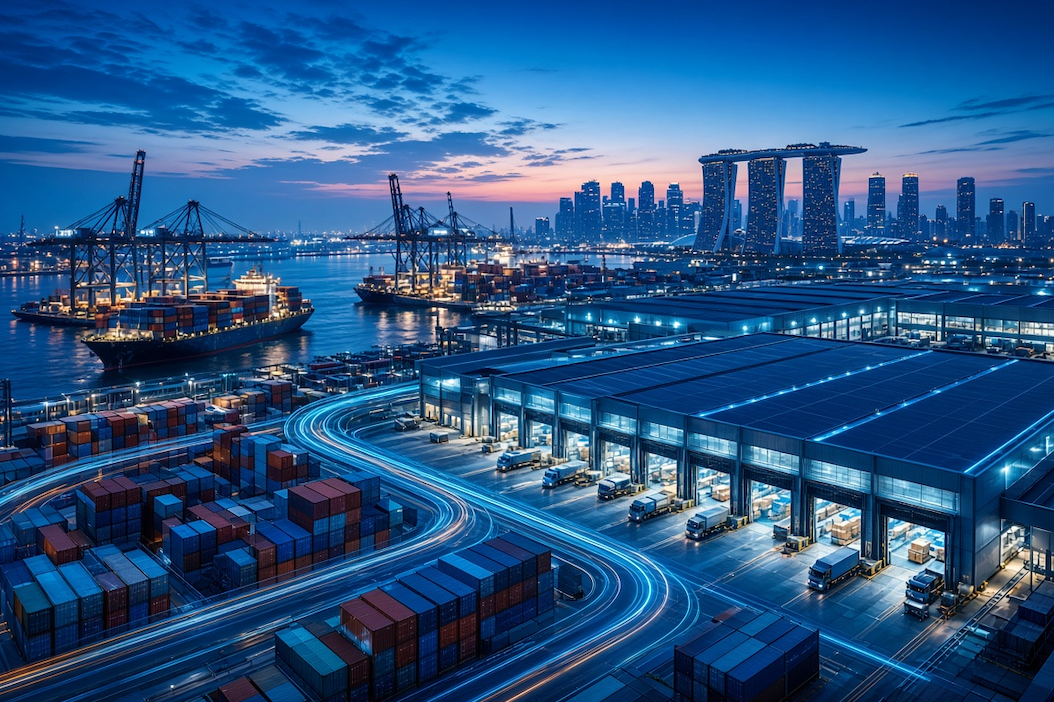
A pharmaceutical distributor storing temperature-controlled vaccines at a bonded facility near Changi Airport can hold inventory for months without paying a cent of duty or Goods and Services Tax, releasing stock into the domestic market only as orders come in and paying tax solely on what leaves the zone.
This deferral mechanism, unremarkable to logistics professionals but transformative for cash flow planning, sits at the heart of why Singapore’s nine free trade zones and its network of licensed bonded warehouses remain central to the country’s role as a regional trading and re-export hub.
How Free Trade Zones Operate Under Singapore Customs
Singapore’s free trade zones are physically designated areas, including sections of the port at Pasir Panjang and Brani, as well as Changi Airport’s air cargo zones, where imported goods can be stored, transhipped, or processed without immediate liability for customs duty and import GST.
Singapore Customs administers the zones under the Free Trade Zones Act, and goods entering an FTZ are treated as though they have not yet formally entered Singapore’s customs territory for tax purposes, even though they have physically arrived.
The mechanics work through a deferral rather than an exemption in most cases. Goods can sit within the zone indefinitely for storage, be re-exported without ever triggering Singapore duty, or be moved into the domestic market, at which point duty and GST become payable based on the goods’ value at that point.
This structure benefits businesses using Singapore as a regional distribution hub, since they can consolidate shipments from multiple origin countries, break bulk, repackage, and re-export to destinations across Asia without the cash flow burden of paying and later reclaiming tax on goods that never enter the domestic Singapore market at all.
Value-added activities permitted within FTZs extend beyond simple storage. Businesses can undertake labelling, quality inspection, minor assembly, and repackaging within the zone, which has made Singapore attractive to companies serving as a regional distribution point for electronics, pharmaceuticals, and specialty chemicals where final packaging or labelling needs to be tailored to destination-market requirements.
Singapore Customs maintains oversight through licensing requirements, inventory audits, and electronic reporting systems that track goods movement in and out of each zone, ensuring the deferral mechanism is not exploited for smuggling or misdeclaration.
Transhipment activity forms a substantial share of what moves through the zones day to day, given Singapore’s position along major East-West shipping lanes. A container arriving from a European manufacturer bound for an Indonesian buyer can transit through an FTZ, being transferred between vessels or consolidated with cargo from other origins, without the goods ever formally entering Singapore’s domestic market and without the shipper incurring Singapore duty at any point in the process.
This transhipment role explains why the free trade zones sit adjacent to the port and airport rather than being distributed evenly across the island, since proximity to the point of vessel or aircraft transfer minimises the additional handling and transport cost layered onto goods that are, in commercial terms, merely passing through.
Eligibility and Licensing for Bonded Warehouse Operators
Bonded warehouses differ from FTZs in an important structural way: rather than being geographically designated zones, they are individual licensed premises anywhere in Singapore that Singapore Customs has approved to store dutiable or GST-suspended goods under bond. This gives businesses more flexibility in location while still accessing similar duty and tax deferral benefits, provided they meet Singapore Customs’ licensing standards.
Operators seeking a licensed warehouse status must satisfy several requirements:
- Physical security standards: premises must meet Singapore Customs specifications for perimeter security, CCTV coverage, and controlled access.
- Inventory control systems: licensees need computerised stock management capable of producing audit trails Singapore Customs can inspect on demand.
- Financial guarantee or bond: operators typically post a security bond covering potential duty and tax liability on goods stored at the facility.
- Compliance track record: applicants with prior customs infractions face additional scrutiny or may be disqualified from licensing.
- Designated personnel: warehouses need trained staff familiar with customs documentation and reporting obligations.
Licensed warehouses serve a broad range of industries, from alcohol and tobacco distributors managing excise-heavy goods to electronics companies using bonded storage as a regional fulfilment base. The licensing process itself typically takes several months from application to approval, and Singapore Customs conducts periodic audits post-licensing to verify continued compliance, meaning warehouse operators treat customs relationship management as an ongoing operational function rather than a one-time approval to secure and forget.
The distinction between a licensed warehouse and a zero-GST warehouse, another Singapore Customs designation aimed specifically at approved traders dealing in non-dutiable goods for re-export, adds a further layer of choice for businesses structuring their storage arrangements.
Companies handling predominantly non-dutiable goods for regional re-export sometimes find the zero-GST warehouse scheme, with its lighter administrative requirements relative to a full bonded licence, a more proportionate fit for their trading pattern, while businesses dealing in dutiable categories such as alcohol, tobacco, or petroleum products have little choice but to pursue full bonded licensing given the excise exposure involved.
Pricing Structures for FTZ and Bonded Storage
The commercial arrangements underlying free trade zone and bonded warehouse usage involve several distinct cost components that businesses need to model carefully when evaluating whether Singapore-based distribution makes financial sense relative to alternative regional hubs.
Typical cost elements include:
- Storage fees: charged per pallet, cubic metre, or square footage depending on the facility, varying with whether the goods require temperature control or specialised handling.
- Handling and value-added service charges: fees for labelling, repackaging, quality checks, or minor assembly performed within the zone.
- Customs bond premiums: for businesses operating their own licensed bonded facility rather than using a third-party operator, the cost of the security bond posted to Singapore Customs.
- Compliance and reporting overhead: internal or outsourced resources dedicated to maintaining the inventory records and customs declarations the deferral regime requires.
- Duty and GST upon domestic release: while deferred, these charges eventually apply to any portion of stored goods sold into Singapore’s domestic market.
Businesses using third-party logistics providers operating within FTZs generally find the arrangement more cost-efficient than establishing their own licensed warehouse unless volumes are large enough to justify the fixed costs of independent licensing.
Many multinational distributors instead contract with established logistics operators who already hold the relevant Singapore Customs licences, effectively renting access to the deferral mechanism without bearing the compliance burden of managing a licensed facility directly.
Negotiating storage contracts with third-party operators involves its own set of commercial considerations beyond the headline per-pallet rate. Minimum commitment volumes, seasonal surcharge clauses tied to peak shipping periods, and service level agreements covering how quickly goods can be released for onward shipment all affect the true cost of using a given facility, and businesses comparing quotes across several logistics providers benefit from modelling total annual cost under realistic volume assumptions rather than comparing headline storage rates in isolation, since the facility with the lowest advertised rate does not always turn out to be the most cost-effective once ancillary charges are factored in.
Industries Best Suited to Free Trade Zone Operations
Certain business models benefit disproportionately from Singapore’s FTZ and bonded warehousing infrastructure, while others find the added complexity unnecessary given their trading patterns.
Industries that most commonly leverage these facilities include:
- Electronics and semiconductor distribution: high-value goods moving through Singapore as a regional consolidation and re-export point before reaching final markets across Asia.
- Pharmaceuticals and medical devices: temperature-controlled bonded storage supporting regional distribution while deferring tax on goods destined for re-export.
- Oil and petrochemical trading: bulk commodity storage and blending activities, especially around Jurong Island’s integrated petrochemical complex.
- Luxury goods and wines: high-duty items where deferral offers meaningful cash flow advantages given the tax rates that would otherwise apply immediately.
- Aerospace parts and maintenance: components stored duty-free while awaiting installation on aircraft undergoing maintenance in Singapore.
Businesses with primarily domestic sales patterns, where goods are imported specifically for immediate sale within Singapore, generally see limited benefit from FTZ or bonded storage arrangements, since the tax deferral advantage is most valuable for goods that will eventually be re-exported or held for extended periods before release into the domestic market.
E-commerce fulfilment has also emerged as a meaningful use case for FTZ infrastructure in recent years, as regional online retailers use Singapore-based bonded facilities to hold inventory close to multiple Southeast Asian markets simultaneously, shipping to individual customers in Malaysia, Indonesia, or Vietnam directly from Singapore stock rather than maintaining separate warehouses in each destination market.
This model works best for higher-value goods where the savings from consolidated inventory and deferred tax outweigh the additional cross-border shipping cost per order, making it a natural fit for categories like electronics accessories, cosmetics, and specialty consumer goods rather than bulky, low-margin items where shipping cost dominates the overall economics.
Compliance Obligations and Customs Audits
Operating within the FTZ and bonded warehouse framework comes with ongoing reporting and compliance obligations that businesses need to build into their operational processes from the outset rather than treating as an afterthought once goods are already moving.
Key obligations include:
- Accurate inventory declarations: goods movement in and out of FTZs and bonded warehouses must be declared through Singapore Customs’ electronic systems, typically via TradeNet.
- Periodic stock reconciliation: licensees must be able to account for the full quantity of goods received against what remains in storage or has been released.
- Timely duty and tax payment: upon release of goods into the domestic market, businesses must correctly calculate and remit applicable duty and GST.
- Retention of documentation: import and export records must be retained for a specified period in case of Singapore Customs audit.
- Reporting of discrepancies: any variance between declared and actual stock must be reported promptly rather than discovered and corrected only during a formal audit.
Singapore Customs conducts both scheduled and unannounced audits of licensed facilities, and the consequences of non-compliance range from financial penalties to suspension or revocation of the operating licence for repeat or serious violations.
Businesses that maintain strong internal controls, often supported by dedicated trade compliance staff or outsourced customs brokerage services, tend to navigate audits with minimal disruption, while those treating compliance loosely face far greater exposure when discrepancies surface.
Technology has increasingly become part of how businesses manage this compliance burden. Warehouse management systems integrated directly with Singapore Customs’ TradeNet platform can automate much of the declaration process, flagging discrepancies in near real time rather than only surfacing them during a periodic manual reconciliation.
Larger logistics operators have invested heavily in this kind of system integration, partly because it reduces the labour cost of compliance and partly because it demonstrably lowers audit risk, a combination that has made technology investment as much a competitive differentiator among third-party FTZ operators as their physical storage capacity or location.
Jurong Island and Sector-Specific Zones
Beyond the general-purpose free trade zones at the port and airport, Singapore has developed sector-specific industrial zones that function on related but distinct principles, most notably Jurong Island, the reclaimed and integrated site housing much of Singapore’s petrochemical and specialty chemicals industry.
Jurong Island operates under its own regulatory and infrastructure framework, distinct from the standard FTZ model, but shares the underlying logic of enabling companies to import, process, blend, and export petrochemical products with efficient customs treatment supporting the island’s role as a regional refining and chemicals hub. Companies operating on Jurong Island benefit from shared infrastructure, including pipelines connecting different plants, that would be prohibitively expensive for any single company to replicate independently.
Other specialised zones include biomedical manufacturing clusters and aerospace maintenance zones near Changi, each tailored to the regulatory and operational needs of their respective industries.
This sector-specific approach reflects a broader Singapore economic development strategy of building infrastructure precisely matched to targeted industries rather than relying solely on generic free trade zone provisions, reinforcing the country’s position not just as a trading hub but as a manufacturing and processing base for specific high-value sectors where proximity, infrastructure sharing, and customs efficiency combine to create durable competitive advantages over less specialised regional alternatives.
Sustainability considerations have begun shaping how these sector-specific zones evolve, especially on Jurong Island, where operators face growing pressure to decarbonise energy-intensive petrochemical processes even as the island continues serving as a cornerstone of Singapore’s manufacturing base.
Investments in carbon capture pilot projects, hydrogen-ready infrastructure, and shared low-carbon energy supply among Jurong Island tenants illustrate how a zone originally built around efficient customs treatment now also functions as a proving ground for the kind of industrial decarbonisation strategies that will shape the island’s competitiveness over the coming decades, with tenant companies increasingly expected to demonstrate credible transition plans as a condition of continued access to shared infrastructure.
Final Thoughts
Singapore’s free trade zones and bonded warehouse network form part of the underlying infrastructure that keeps the country functioning as a regional trading hub rather than merely a domestic market of a few million consumers.
The deferral mechanisms at the heart of this system offer real cash flow advantages to businesses managing regional distribution, but they come with compliance obligations that reward careful operational planning and penalise casual treatment of customs reporting.
For companies weighing whether Singapore-based distribution fits their supply chain, knowing these mechanics in practical rather than theoretical terms is usually the difference between capturing the benefits and drowning in the paperwork, and that practical, hard-won knowledge is precisely what separates businesses that use Singapore’s trading infrastructure well from those that merely pay for access to it without ever fully capturing its value.
Frequently Asked Questions
1. Is GST completely avoided on goods stored in a free trade zone?
No, it is deferred rather than avoided. GST and duty become payable once goods leave the FTZ or bonded warehouse for the domestic market, but goods re-exported directly from the zone never trigger Singapore tax liability.
2. Can any business apply to operate a bonded warehouse?
Any business meeting Singapore Customs’ licensing criteria can apply, but the requirements around security infrastructure, inventory systems, and financial guarantees mean smaller businesses often find it more practical to use a third-party licensed operator instead.
3. How is Jurong Island different from a standard free trade zone?
Jurong Island is a purpose-built integrated industrial zone for the petrochemical and specialty chemicals sector, offering shared infrastructure like pipelines alongside customs efficiencies, rather than operating purely as a general-purpose storage and transhipment zone.
4. What happens if a bonded warehouse fails a customs audit?
Consequences range from financial penalties for minor discrepancies to suspension or revocation of the operating licence for serious or repeated violations, along with potential liability for unpaid duty and tax on unaccounted goods.
5. Do free trade zones only benefit large multinational companies?
No, though larger companies use the infrastructure more extensively. Small and medium enterprises can access the same benefits by using third-party logistics providers already operating within FTZs,
avoiding the cost of establishing their own licensed facility.
6. Can goods be processed or altered while stored in a free trade zone?
Yes, within limits. Permitted activities include labelling, repackaging, quality inspection, and minor assembly, though more substantial manufacturing typically requires different licensing arrangements outside the FTZ framework.