
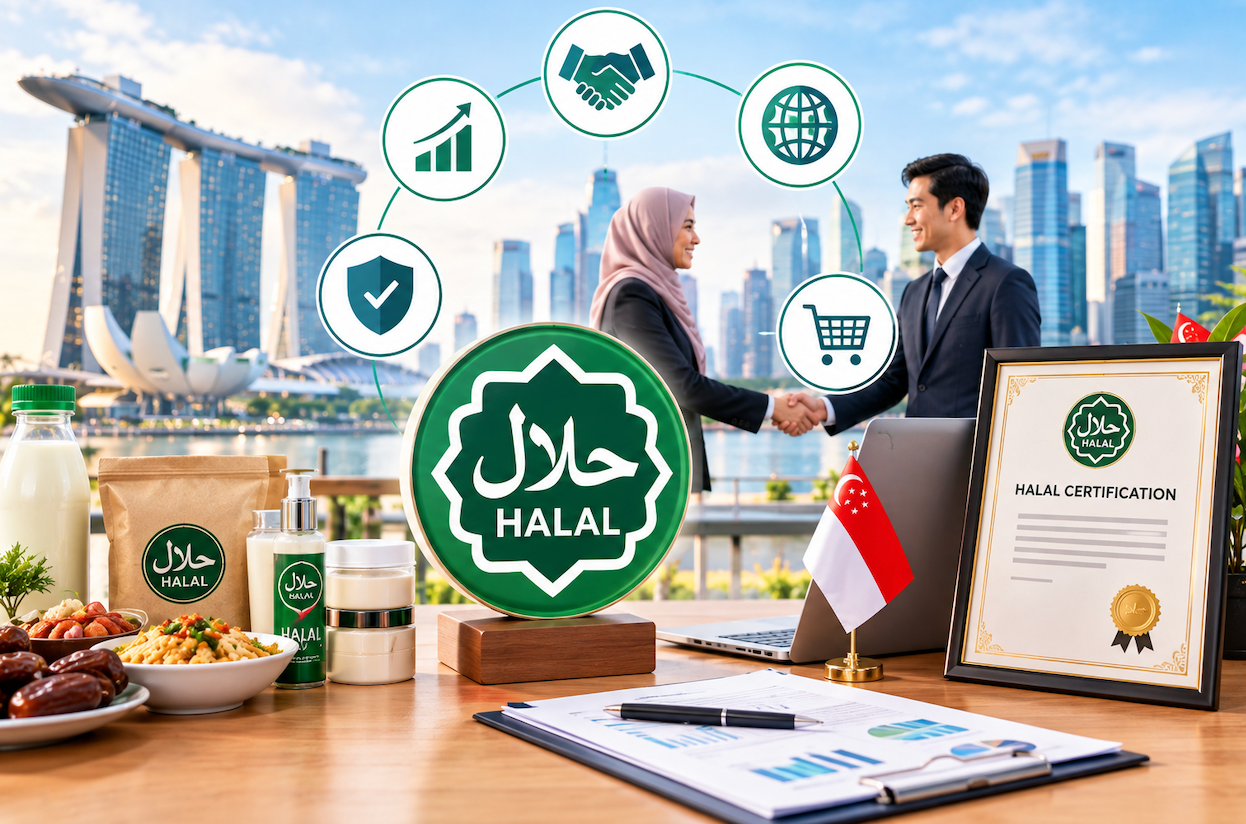
A café in Tanjong Pagar applying for Majlis Ugama Islam Singapura certification discovers the audit covers far more than its menu: cleaning chemicals, storage racks, supplier invoices, and even the sequence in which raw ingredients move through the kitchen all come under review before a certificate is issued.
That level of scrutiny is precisely what gives the MUIS halal mark its commercial weight, both domestically among Singapore’s Muslim community making up roughly 15% of the resident population, and internationally, where the certification is recognised across many markets in the Gulf, Malaysia, Indonesia, and beyond as a credible, rigorously audited standard rather than a self-declared label.
Scope of Halal Certification in Singapore
MUIS halal certification applies across a wide range of business categories, including:
- Food manufacturing
- Food preparation premises, such as restaurants and catering companies
- Abattoirs
- Warehousing and logistics operators handling halal goods
Increasingly, cosmetics and personal care products, as consumer demand for halal-certified beauty items has grown The certification framework distinguishes between different scheme types depending on business activity, with separate standards and audit checklists for restaurants, food manufacturing plants, and logistics operations given that each faces distinct contamination and traceability risks.
At its core, certification verifies that ingredients, production processes, and handling meet Islamic dietary law requirements, meaning no pork or pork derivatives, no alcohol in food preparation, and animals slaughtered according to prescribed methods where applicable, alongside strict segregation protocols preventing cross-contamination with non-halal materials at any point from raw ingredient storage through to final packaging and delivery.
For manufacturing operations, this extends to reviewing supplier certificates for every raw ingredient and packaging material, since a single uncertified additive or shared production line with non-halal products can jeopardise an otherwise compliant operation’s certification status.
Logistics and warehousing certification has become an increasingly important category as Singapore’s role as a regional halal trade hub has grown, requiring dedicated storage areas, transportation protocols preventing contamination during transit, and documentation trails that allow halal status to be verified at every step of a supply chain that might span multiple countries before goods reach their final retail destination.
This comprehensive scope is part of why MUIS certification carries international credibility beyond Singapore’s own market, since the standard addresses the full chain of custody rather than simply the finished product’s ingredient list.
Eligibility and the MUIS Certification Process
Eligible applicants must be legally registered businesses in Singapore operating premises or supply chains that can be audited. The process then runs through several stages:
- A formal submission to MUIS detailing the business’s products, processes, and premises
- Document review covering supplier certificates, recipe formulations, and standard operating procedures
- On-site inspections by MUIS auditors, examining physical segregation of halal and non-halal materials, staff training on halal handling protocols, and cleaning and sanitation practices that prevent cross-contamination between production runs
The certification timeline typically spans several weeks to a few months depending on business complexity, with straightforward single-location restaurants generally processing faster than multi-site manufacturing operations with extensive supplier networks requiring individual verification.
Businesses must also designate an internal halal executive or committee responsible for maintaining compliance between formal audits, since MUIS conducts periodic surprise inspections and requires certified businesses to report any changes in suppliers, recipes, or premises that could affect halal status.
Renewal is not automatic; certified businesses must undergo periodic reassessment, typically on an annual or multi-year cycle depending on the certification scheme, with any lapse in compliance discovered during renewal audits potentially resulting in certification suspension until corrective action is verified.
Businesses expanding into new product lines or opening additional premises generally need to extend or reapply for certification covering the new scope, meaning halal compliance is an ongoing operational discipline rather than a one-time achievement, a distinction that surprises some first-time applicants who assume the initial certificate covers all future business activity indefinitely.
Expenses and Renewal Requirements
Certification costs vary by business type and scale, generally comprising an application fee, an audit fee covering the cost of MUIS inspector time, and ongoing costs associated with maintaining compliant infrastructure such as separate storage areas, dedicated equipment, or staff training programmes. Smaller food and beverage outlets typically face lower absolute costs than large-scale manufacturing operations with complex supply chains requiring extensive documentation review across dozens or hundreds of individual suppliers and ingredients.
Beyond direct certification fees, businesses often incur indirect costs adapting physical premises to meet segregation requirements, which can include renovating kitchen layouts, acquiring dedicated equipment that cannot be shared with non-halal food preparation, and investing in staff training to ensure consistent compliance with handling protocols across all shifts and personnel.
For manufacturers, verifying and documenting the halal status of every ingredient and packaging material supplier can itself be a meaningful administrative undertaking, above all for businesses with complex, globally sourced supply chains where individual ingredient suppliers must themselves hold recognised halal certification.
Renewal costs are generally lower than initial certification given that much of the foundational documentation and infrastructure is already in place, though businesses that have made significant changes to products, premises, or suppliers since their last audit should budget for a more extensive renewal review comparable in scope to the original certification process.
Many businesses find that the ongoing administrative cost of maintaining certification, including designated staff time for compliance monitoring and periodic internal audits, exceeds the direct fees paid to MUIS itself over the certification’s lifetime, an important budgeting consideration for businesses evaluating whether certification aligns with their target market and growth strategy.
Business Value Across Food, Cosmetics and Logistics Certification delivers commercial value differently depending on the type of business:
Food and beverage businesses:
Halal certification directly expands the addressable customer base by making the establishment accessible to Muslim consumers who might otherwise avoid uncertified premises entirely, a meaningful commercial consideration in a market where Muslim residents represent a substantial and often loyal customer segment especially attentive to certification status when choosing where to dine.
Certification also frequently serves as a prerequisite for securing contracts with institutional buyers including schools, hospitals, and government catering tenders that specify halal-certified vendors as a procurement requirement.
Manufacturers and exporters:
MUIS certification opens doors to markets well beyond Singapore’s own borders, given mutual recognition arrangements and the certification’s strong reputation across Malaysia, Indonesia, Gulf Cooperation Council countries, and other markets with substantial Muslim populations. This export dimension has become increasingly important as Singapore positions itself as a regional hub for halal-certified food processing and trade.
Cosmetics, pharmaceuticals, and personal care companies:
Have increasingly pursued halal certification as global demand for halal-compliant beauty and wellness products grows, recognising that ingredient sourcing and manufacturing process requirements for halal cosmetics certification similarly signal rigorous quality and sourcing standards that can appeal to a broader consumer base beyond strictly religious considerations.
Typical Compliance Pitfalls
Several recurring pitfalls put certification status at risk:
Unreported supply chain changes:
Made without updating MUIS on ingredient or supplier substitutions, notably when a business switches suppliers for cost reasons without verifying the new supplier’s own halal certification status, inadvertently compromising certification even when the switch seemed minor from an operational standpoint.
Cross-contamination risk from shared equipment or premises:
Specifically for smaller food businesses operating in shared kitchen facilities or central production kitchens serving multiple brands, where maintaining strict physical and procedural segregation between halal and non-halal production becomes logistically challenging.
Staff turnover:
Since halal handling protocols depend heavily on consistent staff training and adherence, and businesses with high turnover in food preparation roles, common in Singapore’s hospitality sector, must maintain rigorous onboarding and refresher training programmes to ensure new staff recognise and follow segregation and handling requirements correctly.
Benchmarking Against Regional Halal Certifiers
Malaysia’s JAKIM certification is often considered the most internationally recognised halal standard in Southeast Asia alongside MUIS, with both bodies maintaining mutual recognition arrangements that ease cross-border trade of certified products between the two countries, an important relationship given the deep economic integration and shared consumer base across the Causeway.
Indonesia’s BPJPH, which took over halal certification responsibilities from a previous body, oversees the world’s largest single Muslim consumer market, and Singapore exporters targeting Indonesia need to navigate that country’s own certification requirements even when holding MUIS certification, since full mutual recognition is not universal across all product categories.
Gulf Cooperation Council countries maintain their own national halal standards bodies, and while MUIS certification is broadly respected and often accepted, exporters targeting these markets should verify specific import requirements, as some Gulf markets require either direct certification recognition agreements or additional local certification processes depending on the product category and importing country’s specific regulations at any given time.
Singapore’s particular strength relative to regional certifiers lies in the rigour and consistency of its audit process, reinforced by MUIS’s standing as a well-resourced, professionally staffed statutory body rather than a purely voluntary industry association, giving the certification a credibility that supports Singapore’s broader positioning as a trusted hub for halal food processing, logistics, and re-export trade serving the wider region, a reputation built over decades of consistent enforcement rather than a recent marketing positioning.
Export Opportunities in Halal Markets
Singapore’s strategic location and logistics infrastructure position halal-certified businesses to serve as a re-export and processing hub for the broader Muslim-majority markets across Southeast Asia, South Asia, and the Middle East, leveraging the country’s free trade agreement network and PSA-operated port facilities to move certified goods efficiently across the region.
Food manufacturers in particular have used Singapore-based, MUIS-certified production facilities as a base for exporting processed foods, sauces, and packaged goods to markets where Singapore’s certification carries strong trust even without additional local certification in some product categories.
The global halal economy, spanning food, cosmetics, pharmaceuticals, tourism, and finance, represents a market with substantial and growing consumer spending power, driven by both population growth in Muslim-majority countries and increasing halal consumption among non-Muslim consumers who associate the certification with quality and ethical sourcing standards.
Singapore-based businesses that build export strategies around halal certification from an early stage, rather than treating it as an afterthought once domestic operations mature, tend to design supply chains and product formulations more efficiently for international scaling rather than needing costly retrofits later.
Trade missions and business matching services facilitated through Enterprise Singapore and industry associations increasingly feature halal-certified Singapore businesses seeking distribution partnerships in target export markets, reflecting growing government recognition of the halal economy as a distinct growth vertical worth dedicated trade promotion support alongside more traditional sector-focused export initiatives.
Supply Chain Requirements Behind a Halal Label
A MUIS certificate covers far more than the finished product leaving a factory; it extends across several links in the supply chain:
Raw ingredient sourcing:
Food manufacturers seeking certification must document the halal status of every ingredient supplier, including flavourings, emulsifiers, and processing aids that make up a small fraction of a product’s weight but can disqualify an entire batch if their origin cannot be verified.
Production line segregation:
Shared production facilities present a particular challenge, since a factory that also runs non-halal lines must demonstrate physical or scheduled separation sufficient to prevent cross-contamination, often requiring dedicated equipment, separate storage areas, and staff trained specifically in halal handling protocols.
Logistics partner handling practices:
Goods must retain their halal status as they move from factory to shelf, which places compliance obligations on transport and warehousing partners as well as the manufacturer itself.
Logistics adds another layer of complexity that businesses new to certification frequently underestimate. Warehousing and transport providers moving certified goods must themselves follow practices that preserve halal status in transit, which has led some Singapore logistics companies to build out dedicated halal-compliant storage and delivery services as a distinct commercial offering.
Retailers stocking certified products also bear some responsibility for maintaining separation on shelves and in point-of-sale handling, especially for fresh and prepared foods where the risk of cross-contamination is highest.
Businesses that treat certification as purely a manufacturing concern, without extending the same discipline through their supply chain partners, risk having their certification suspended during an audit even when their own factory floor is fully compliant.
Costs and Timelines for First-Time Applicants
Certification costs vary by business size and product complexity, with fees structured around factors including the number of product lines, factory size, and whether the applicant is a first-time or renewal case. Beyond the direct application fee, businesses typically incur costs for ingredient reformulation where a current supplier cannot provide adequate halal documentation, staff training on handling protocols, and in some cases physical modifications to production areas to achieve adequate segregation.
Smaller food and beverage businesses sometimes find these upfront costs a meaningful barrier, which is part of why government grants and trade association support programmes exist specifically to help smaller applicants offset the initial investment.
Timelines from application to certificate issuance typically run several months, depending on how quickly an applicant can supply complete supporting documentation and how many rounds of factory inspection and correction are needed before requirements are fully met.
Businesses that engage a halal compliance consultant early, or that have already built relationships with certified ingredient suppliers, generally move through the process faster than first-time applicants building their supply chain from scratch. Renewal audits, required periodically to maintain certification, tend to be faster than initial applications since MUIS assessors are working from an established compliance history rather than evaluating a facility for the first time.
Final Thoughts
Halal certification in Singapore functions as both a religious compliance framework and a serious commercial asset, opening access to a substantial domestic Muslim consumer base while positioning certified businesses for export opportunities across a global halal economy worth considerable and growing consumer spending.
The rigour of the MUIS audit process, while demanding in terms of documentation, supplier verification, and ongoing operational discipline, is precisely what gives the certification its international credibility and long-term commercial value.
Businesses that treat certification as an integrated part of supply chain design and export strategy from the outset, rather than a compliance checkbox, tend to extract the greatest commercial return from the investment of time and resources certification requires.
Read more about Singapore Trends
Frequently Asked Questions
1. How long does MUIS halal certification typically take to obtain?
Processing time generally ranges from several weeks for straightforward single-location food outlets to a few months for larger manufacturing operations with extensive supplier networks requiring individual documentation review, though timelines vary based on business complexity and how prepared the applicant’s documentation is at submission.
2. Does halal certification apply only to food businesses?
No. While food and beverage remains the largest certified category, MUIS certification also covers cosmetics, pharmaceuticals, logistics and warehousing operations, and other product categories where consumer demand for verified halal compliance has grown alongside the food sector.
3. Is MUIS certification recognised outside Singapore?
Broadly yes, given MUIS’s strong international reputation and mutual recognition arrangements with certifiers in Malaysia and several other markets, though exporters should verify specific import requirements for each target market since full recognition is not universal across every country and product category.
4. What happens if a certified business fails a renewal audit?
Depending on the severity of non-compliance found, outcomes can range from a corrective action period with a follow-up audit to suspension or revocation of certification, which can have immediate commercial consequences if the business relies on the halal designation for institutional contracts or export market access.
5. Can a business operate without halal certification and still serve Muslim customers?
Yes, businesses can operate without certification, but they cannot represent themselves as halal-certified, and many Muslim consumers, especially for dining establishments, actively prefer or require certified premises, meaning uncertified businesses may see a narrower addressable customer base within Singapore’s Muslim community.
6. Does halal certification guarantee access to Gulf export markets?
Not automatically. While MUIS certification carries strong credibility, some Gulf Cooperation Council markets require additional local certification or specific recognition agreements depending on the product category, so exporters should verify current requirements for each target market rather than assuming Singapore certification alone suffices everywhere.