
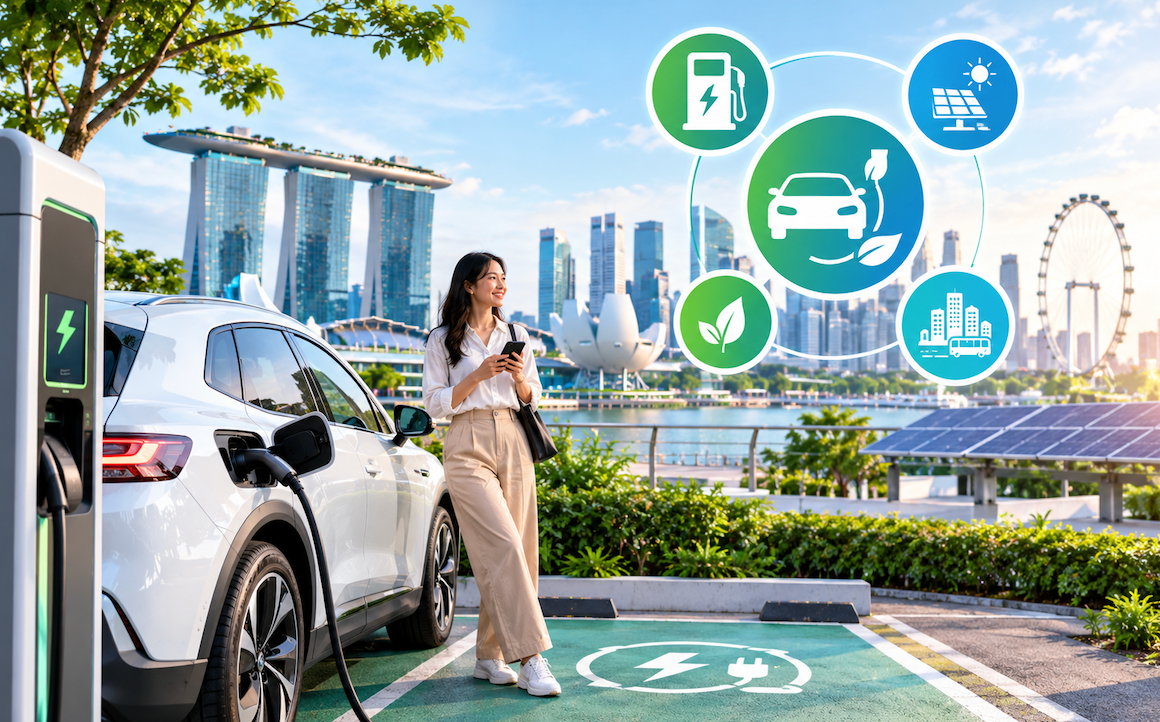
A car buyer browsing showrooms along Leng Kee Road in 2024 found electric vehicle pricing looking markedly more competitive than it had just a few years earlier, thanks to the Vehicular Emissions Scheme rebates and the EV Early Adoption Incentive that reduced the Additional Registration Fee for qualifying electric cars registered before the end of 2025.
That shift reflects a deliberate, multi-pronged government push to move Singapore’s vehicle fleet toward electrification ahead of a stated goal to have all new car and taxi registrations be cleaner-energy models by 2030, a target that requires overcoming both cost barriers and Singapore’s particular constraints around charging infrastructure in a land-scarce, high-rise residential city.
How Singapore’s EV Incentive Framework Works
The Vehicular Emissions Scheme grades vehicles based on their emissions of pollutants and carbon dioxide, offering rebates on the Additional Registration Fee for cleaner vehicles, including full rebates for qualifying electric models, while imposing surcharges on higher-emission vehicles.
Layered on top of this, the EV Early Adoption Incentive provided an extra rebate specifically for electric cars registered within a defined early window, designed to narrow the upfront cost gap between electric vehicles and comparable petrol models during the years when EV prices remained less competitive without subsidy support.
Beyond registration incentives, the government has also addressed the Certificate of Entitlement system, which governs the right to register any vehicle in Singapore regardless of fuel type, meaning EV buyers still face the same competitive bidding process for vehicle ownership quota as buyers of conventional cars.
This means EV incentives reduce specific fee components tied to emissions but do not exempt buyers from Singapore’s broader vehicle population control framework, a distinction that sometimes surprises first-time EV buyers expecting electric vehicles to bypass COE costs entirely.
Road tax structures have also been revised to reflect the different cost basis of running an electric vehicle, since traditional road tax calculations tied to engine capacity do not translate naturally to electric motors, which lack a directly comparable displacement figure.
The Land Transport Authority introduced a road tax schedule for electric vehicles based on power output instead, adjusted over time to keep the tax burden roughly comparable to what an equivalent petrol vehicle owner would pay, an attempt to maintain revenue neutrality across fuel types rather than allowing the tax base to erode as the vehicle fleet shifts toward electrification.
Charging Infrastructure and the Housing Challenge
Singapore’s housing profile, with the large majority of residents living in public housing flats without private garages or dedicated parking with easy access to individual power points, creates a charging infrastructure challenge distinct from many countries where home charging in a private driveway is the norm.
The government’s EV charging roadmap, coordinated through the Land Transport Authority and various town councils, has targeted installing charging points across a substantial share of public and private parking facilities, including HDB carparks, to make charging accessible to residents without private home charging options.
Private charging point operators, including companies like SP Group and various commercial charging network providers, have expanded public charging infrastructure at shopping malls, commercial buildings, and dedicated charging hubs, supplementing the slower rollout of HDB carpark charging points.
This infrastructure buildout remains an ongoing process, and charging point availability, above all for fast-charging options rather than slower overnight charging, continues to lag some EV owners’ convenience expectations, creating friction that policymakers acknowledge as a key remaining barrier to broader adoption beyond early adopters.
Workplace charging has emerged as a complementary solution some employers have begun offering as a staff benefit, not least companies with campuses that already have dedicated parking facilities, allowing employees to charge during working hours rather than relying solely on overnight home or public charging.
Shopping malls and large commercial landlords have also increasingly installed charging bays as a tenant and shopper amenity, partly in response to consumer expectation but also because charging infrastructure can extend the average duration a shopper spends on the premises, indirectly benefiting retail and dining tenants through longer visit durations while a vehicle charges.
Who Is Driving Early EV Adoption
Early EV adopters in Singapore have skewed toward higher-income households able to absorb any remaining price premium even after incentives, alongside environmentally motivated buyers willing to accept some charging convenience trade-offs in exchange for reduced emissions.
Corporate and commercial fleets, including taxi and private-hire vehicle operators, represent another significant adoption segment, partly driven by operator-level sustainability commitments and partly by the lower running costs electric vehicles offer for high-mileage commercial use compared to petrol vehicles.
Households living in landed properties or condominiums with dedicated parking and easier access to private charging installation have found the EV ownership experience far smoother than HDB residents dependent on shared public charging infrastructure, creating a de facto adoption gap correlated with housing type that policymakers have specifically targeted through the accelerated HDB charging point rollout program.
Age and life stage also shape adoption patterns, with younger buyers purchasing their first vehicle showing somewhat higher openness to electric models compared to older drivers accustomed to the refuelling routines of petrol vehicles, according to periodic consumer surveys conducted by industry groups.
Families with young children have generally shown more caution around EV adoption, citing concerns about charging reliability for longer road trips, even though the vast majority of daily driving in a small city-state like Singapore falls well within the range capabilities of virtually all electric models currently on the market.
Business and Economic Implications
Automotive dealers and distributors have had to restructure showroom offerings and sales training as electric models move from a niche product line to a central part of new vehicle sales, with several major brands expanding their Singapore EV model lineups substantially in response to both incentive-driven demand and shifting global manufacturing priorities toward electric platforms.
Vehicle servicing and maintenance businesses face a structural shift as well, since electric vehicles require different maintenance skill sets and generally need less frequent servicing than internal combustion vehicles, a change with implications for the traditional car workshop industry’s business model.
Insurance providers have also had to adjust underwriting models for electric vehicles, factoring in differences in repair costs, since EV battery packs and specialized components can be more expensive to replace than equivalent petrol vehicle parts, even as routine maintenance costs run lower overall.
Some insurers have introduced EV-specific policies with premium structures reflecting this different risk and cost profile, while training programs for auto repair technicians have expanded to cover high-voltage system safety, a skill set not previously required for technicians trained exclusively on internal combustion vehicles.
The broader push toward electrification also connects to Singapore’s carbon tax and climate commitments, since transport emissions represent a meaningful share of the country’s overall carbon footprint, and reducing this share supports progress toward net-zero targets.
Electricity demand from a growing EV fleet also has implications for grid planning, requiring coordination between transport electrification goals and Singapore’s parallel efforts to diversify its electricity generation mix, including imported renewable electricity and expanded solar deployment.
Trade-Offs and Criticism of the Current Approach
Some consumer advocates have argued that despite substantial incentives, electric vehicles in Singapore remain more expensive on a total cost basis than in many other markets, given that Singapore’s baseline vehicle ownership costs, driven by the Certificate of Entitlement system, are already among the highest in the world regardless of fuel type.
This means EV incentives narrow the gap between electric and petrol vehicles within Singapore’s uniquely expensive ownership environment but do not necessarily make EV ownership cheap in absolute terms compared to countries with lower overall vehicle taxation.
Critics have also raised concerns about the pace of charging infrastructure rollout relative to the ambitious 2030 target for all new registrations to be cleaner-energy vehicles, arguing that infrastructure development has periodically lagged behind policy ambition, potentially creating a bottleneck that limits broader adoption beyond early adopters with easier access to charging.
The government has acknowledged infrastructure as a critical dependency and has periodically adjusted rollout targets and funding commitments in response to this feedback.
Environmental groups have raised a further nuance to the sustainability case for EV adoption, pointing out that the emissions benefit of switching to electric vehicles depends heavily on how clean Singapore’s electricity grid is, and since the country still relies predominantly on natural gas for power generation, the net carbon reduction from vehicle electrification today is smaller than it would be in a country with a largely renewable grid.
This has led some analysts to argue that EV adoption policy and electricity grid decarbonization policy need to be pursued as a coordinated package rather than as separate initiatives, since accelerating one without the other only partially delivers on the climate rationale originally used to justify the EV incentive program.
Comparing Singapore’s EV Strategy to Other Markets
Norway, often cited as the global leader in EV adoption rates, achieved its position through a combination of substantial tax exemptions for electric vehicles and abundant hydroelectric power supporting cheap electricity, conditions that differ substantially from Singapore’s land-scarce, densely populated context and its reliance on imported natural gas for the bulk of electricity generation.
China’s EV strategy has leaned heavily on domestic manufacturing subsidies to build a globally competitive electric vehicle industry, a different emphasis from Singapore’s approach, which focuses more narrowly on adoption incentives and infrastructure rather than trying to develop domestic vehicle manufacturing capability.
Within the region, Singapore’s EV adoption push places it ahead of most Southeast Asian neighbors in terms of policy sophistication and incentive structure, though smaller markets like Thailand have pursued aggressive manufacturing-focused strategies to attract Chinese EV manufacturers to establish regional production bases, a different strategic emphasis given Thailand’s existing automotive manufacturing base compared to Singapore’s role primarily as a vehicle importer and consumer market rather than a production hub.
Indonesia has taken yet another approach, leveraging its position as a major producer of nickel, a key battery material, to attract investment across the EV supply chain rather than focusing narrowly on consumer adoption incentives, illustrating how differently resource endowments and existing industrial bases shape each Southeast Asian country’s EV strategy even as all pursue the shared regional goal of reducing transport emissions.
Future Outlook and Practical Guidance
The years leading up to 2030 will likely bring continued expansion of charging infrastructure, especially in HDB estates, alongside potential adjustments to incentive structures as EV prices continue falling globally and the initial cost gap with petrol vehicles narrows without subsidy dependence.
Expect closer integration between EV policy and Singapore’s broader electricity grid decarbonization efforts, since the climate benefit of vehicle electrification hinges on the carbon intensity of the electricity used to charge those vehicles.
Prospective EV buyers should factor in realistic charging access based on their housing type and daily driving patterns before purchasing, rather than assuming public charging infrastructure will always be conveniently available, not least for HDB residents without confirmed access to a nearby charging point.
Businesses operating vehicle fleets should model total cost of ownership carefully, accounting for incentive timelines, since the more generous early adoption incentives were time-limited and later purchases may face different, and potentially less generous, incentive structures depending on the policy’s ongoing review cycle.
How Charging Infrastructure Rollout Has Shaped Adoption Patterns
The pace of public charging infrastructure installation across Housing and Development Board carparks, private condominiums, and commercial locations has had a direct and measurable effect on where electric vehicle adoption has concentrated first, with early adopters clustering in private housing developments where dedicated charging points could be installed more easily than in older public housing estates with more constrained electrical capacity.
The government’s EV Common Charger Grant and related infrastructure programs have specifically targeted this imbalance, subsidizing charger installation in HDB carparks to prevent electric vehicle ownership from becoming disproportionately concentrated among private property owners with easier access to home charging.
Commercial charging networks operated by several private companies have expanded steadily at shopping malls, office buildings, and petrol stations, giving EV owners without dedicated home charging a growing set of options for topping up during regular daily activities rather than requiring a dedicated charging trip. Despite this expansion, charging availability during peak evening hours in dense residential areas remains a practical constraint that some prospective buyers weigh heavily when deciding whether to switch from a conventional vehicle, those living in older estates where charger installation has lagged behind newer developments.
What Fleet Operators Are Learning From Early Electrification Efforts
Commercial fleet operators, including taxi companies, delivery services, and corporate vehicle fleets, have served as an important early testing ground for electric vehicle adoption at scale, generating practical operational data that individual consumers rarely produce on their own given the comparatively low annual mileage of a typical private car.
Fleet operators running electric taxis and delivery vehicles have reported that total cost of ownership calculations often favor electrification once daily mileage climbs high enough to make fuel savings outweigh the higher upfront purchase price within a reasonable number of years, a threshold that private car owners driving far less each day may not reach as quickly.
These fleet experiences have also surfaced practical lessons around battery degradation under intensive daily use, the importance of scheduling charging around shift patterns to avoid downtime, and the value of maintaining a small buffer of spare vehicles to cover charging periods, insights that vehicle manufacturers and charging network operators have used to refine their offerings for both commercial and eventual mass-market residential customers.
Final Thoughts
Singapore’s electric vehicle strategy reflects the country’s characteristic approach to policy: a carefully calibrated mix of financial incentives, infrastructure investment, and long-term targets designed to manage a structural transition within the constraints of a small, dense, land-scarce city-state.
Charging infrastructure, especially for HDB residents, remains the most consequential bottleneck standing between current adoption levels and the 2030 target. As incentive structures evolve and infrastructure investment continues, Singapore’s experience may offer a useful reference point for other dense, high-rise cities working through similar electrification challenges.
The coming years will likely be a period in which the policy’s early, incentive-heavy phase gives way to a more infrastructure- and grid-focused phase, one where success is measured less by headline adoption figures and more by whether ordinary residents, not just enthusiastic early adopters, find EV ownership a practical and unremarkable everyday choice.
Getting there will require charging infrastructure, grid decarbonization, and consumer incentives to advance together rather than in isolation, since progress on only one front leaves the overall transition only partially complete.
Frequently Asked Questions
1. Do electric vehicles in Singapore still require a Certificate of Entitlement?
Yes, all vehicles registered in Singapore, including electric ones, require a Certificate of Entitlement obtained through the competitive bidding system. EV-specific incentives reduce or eliminate the Additional Registration Fee for qualifying models but do not exempt buyers from the COE requirement.
2. How does the Vehicular Emissions Scheme benefit electric vehicle buyers?
The scheme grades vehicles by emissions and offers rebates on registration fees for cleaner vehicles, including electric models, while imposing surcharges on higher-emission vehicles. This effectively lowers the relative cost of purchasing an electric vehicle compared to a higher-emission petrol equivalent.
3. Can HDB residents easily charge an electric vehicle at home?
Charging access for HDB residents depends on whether their specific carpark has been fitted with charging points, since most HDB flats lack private parking with dedicated power access. The government has been progressively expanding charging point installation across HDB carparks to address this gap.
4. Is owning an electric vehicle cheaper than a petrol car in Singapore?
Incentives narrow the price gap between electric and petrol vehicles, and EVs generally have lower running and maintenance costs, but Singapore’s overall vehicle ownership costs, driven by the Certificate of Entitlement system, remain high regardless of fuel type compared to many other countries.
5. What is Singapore’s target for electric vehicle adoption?
The government has set a goal for all new car and taxi registrations to be cleaner-energy models, including electric vehicles, by 2030, as part of a broader strategy to reduce transport-related carbon emissions in line with national climate commitments.
6. How does Singapore’s EV strategy compare to Norway’s?
Norway achieved very high EV adoption through substantial tax exemptions and access to cheap hydroelectric power, conditions quite different from Singapore’s land-scarce environment and reliance on imported natural gas for electricity generation, meaning direct comparisons of adoption pace should account for these structural differences.