Singapore has begun sending formal notices to companies the authorities say were identified in connection with this month’s haze, a step beyond the usual diplomatic appeals. For readers, the headlines raise fair questions: does a notice mean a company has been found at fault, and will anything change in the air we breathe?
In this article, we will discuss the law behind the notices, what they require, the penalties on paper, the pressure from financial markets, and the limits of what any notice can achieve.
The Law Behind the Notices
A statute from 2014
The Transboundary Haze Pollution Act (THPA) was enacted in 2014. It was written for a problem that no ordinary Singapore statute could reach: smoke generated outside our borders that nevertheless damages health and daily life here. Its design is that an entity, which can be a company and not only an individual, may be held to account for conduct overseas if that conduct causes or contributes to haze pollution in Singapore. The fine print of the Act is long, and anyone with a specific legal interest should read it on Singapore Statutes Online or ask a lawyer. Our companion article on the haze episode covers the health and school measures, so this one stays with the legal and corporate side.
When an episode counts
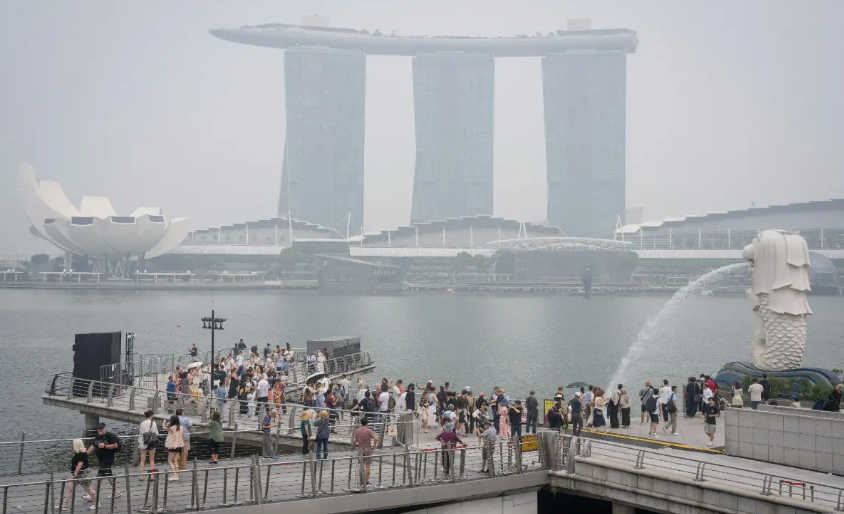
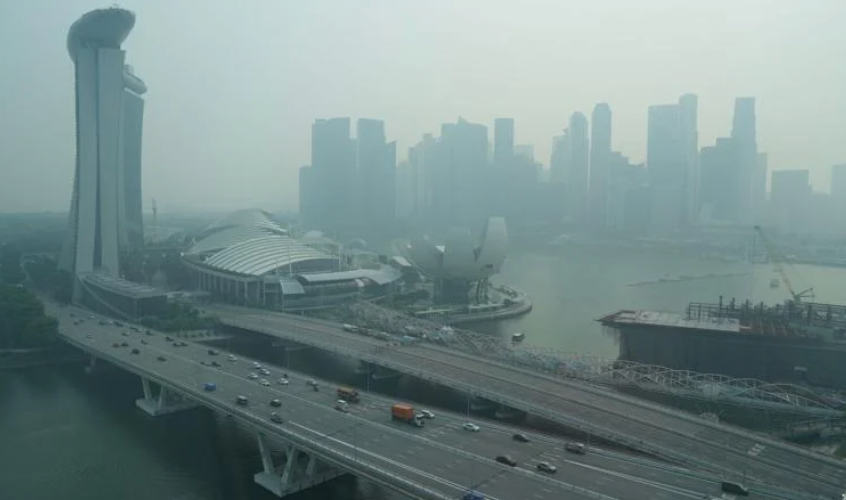
The Act uses a defined trigger. According to Little Big Red Dot, a poor-air-quality episode starts when the 24-hour PSI reaches 101 or higher in any part of Singapore and stays there for 24 hours or more. The phrase “any part of Singapore” is important, because it means a single region can start the clock even when the rest of the island is cleaner. Singapore has been above that line in at least one region since early October, so the statutory condition is plainly a live issue this month.
Crossing the threshold is not enough
A threshold on the air quality index describes the problem, not the culprit. Little Big Red Dot noted that crossing the threshold alone does not make anyone liable. Authorities must show that a company caused or contributed to the haze. That is a demanding task. It means connecting a particular fire, on particular land, controlled by a particular entity, with smoke that arrived over Singapore on particular days. Smoke from many fires mixes in the air, and a plume does not carry a label.
This is also why the Act gives the agency a gentler first tool than prosecution. A preventive measure notice lets NEA ask for concrete action while the slower work of proving responsibility goes on in the background. The logic is similar to a warning from a building inspector who sees a hazard: the inspector does not need to prove who created it before telling the owner to make it safe. Whether that logic works across a border depends heavily on cooperation, a theme we return to later.
Announcements in Mid-October
The first seven notices
On 16 October, at a press conference with Minister Grace Fu, Minister Desmond Lee and Acting Minister Jasmin Lau, NEA announced preventive measure notices to seven Indonesian companies in Sumatra. These were the companies identified for the haze on 8 and 9 October. Three of them had received similar notices in 2015. Reporting on the day said that the owners of the companies and their links were still under investigation, and NEA said that its investigations into four companies suspected in connection with the 2015 haze are continuing.
The fact that three of the seven had been served before deserves a careful reading. It shows that the instrument has been used in the past and that the same names, or at least the same concessions, can come to NEA’s attention more than once. It does not show that any conduct this year was wrong, and a repeat notice is not evidence of guilt. Readers who want to judge the story fairly should wait for what the investigations produce, not for the number of notices alone.
Three more on 19 October
According to the Associated Press, NEA announced on 19 October that three more Indonesian companies, with concessions in Kalimantan, had been issued notices. That brought the total to 10 companies.
The addition of Kalimantan matters because NEA’s own update of 18 October said smoke from Kalimantan was still drifting towards Singapore, so the notices follow the geography of the smoke and not only Sumatra, which is often the first place people think of.
The evidence behind the identification
The evidence cited for the identification of the companies was concession maps, meteorological data, and satellite imagery, some of it from open sources. Each type does a different job. Concession maps show which entity holds rights to which parcel of land. Satellite imagery shows where fires are burning and when. Meteorological data shows which way the wind was blowing, and therefore whether smoke from a given area could reach Singapore at the relevant time. Joined together, these sources can point to a likely origin. They are a starting point for an investigation, and the reports that ownership links were still being examined are a reminder that a name on a concession map is not the same as proof of who lit a fire.
| Date | Step | Detail |
| 8 and 9 October | Haze episode period | Companies later identified for the haze on these days |
| 16 October | First announcement | Notices to seven Indonesian companies in Sumatra |
| 19 October | Second announcement | Notices to three more companies with Kalimantan concessions, making 10 |
| 19 October | Exchange queries | Singapore Exchange asks seven Singapore-listed agricultural companies for information |
Obligations Placed on the Companies
Firefighting on the ground
The notices direct companies to deploy firefighting personnel. This is the most immediate requirement, and in a practical sense the most valuable. A fire caught early on a concession can be contained by a few trained crews with equipment, while a fire on drained peat can burn underground for weeks and is far harder to put out. The point of the notice is therefore to move the cost and effort of firefighting on to the entity that controls the land.
Stopping or not starting burning
Companies are also directed to stop burning on their land, or not to start it. Land clearing by fire is cheap, which is why it persists, and it is also the practice that national directives in Indonesia have been
aimed at. A notice that restates the prohibition in a formal Singapore instrument creates a record: if fires reappear on a concession after a notice, the issue of whether the company complied becomes a matter of evidence, not of opinion.
Action plans for NEA
Finally, companies must submit action plans to NEA setting out how they will extinguish the fires and prevent a recurrence. A good plan would normally identify the personnel and equipment, the monitoring arrangements, the water management for peatland and the lines of responsibility. NEA can then compare what the plan promises against what satellite imagery later shows. The action plan is probably the part of the notice most likely to have long-term value, because it ties a company to specific, checkable commitments.
The reports used for this article do not state deadlines for filing the plans or for the other steps, and they do not say what NEA will publish about compliance. Those details matter, since a notice with no timetable is easy to delay. Readers should look to NEA’s announcements for any follow-up, and should be cautious about commentary that claims to know what has or has not been done on the ground. Satellite images can show whether fires have stopped, but a company’s internal efforts are hard to see from outside.
Notice Versus Verdict
Public discussion tends to blur the steps of a regulatory process, so it is worth setting out what each one means.
The Associated Press stressed an important point: a notice is not a finding of legal responsibility. What it does is allow prosecution and penalties if the legal requirements for an offence are met. That wording is careful, and readers should respect it. A notice is a regulatory step taken to prompt action while an investigation continues.
It is not a conviction, a fine or a court order. It is not a ban on a company’s trading, and it is not a statement about every company in the same group. It does not decide who owns or controls the land, which reports say is still being examined. For that reason, this article does not name the companies and does not suggest that any of them is guilty. Any entity in this position is entitled to respond and, if it is ever charged, to defend itself before a court.
There is a second sense in which a notice falls short of a verdict. It does not by itself clean the air. A notice that leads to quick firefighting may help, but whether the smoke thins depends on rain, wind, soil conditions and the actions of many parties beyond the ten companies.
Penalties and Civil Claims
Fines on paper
For an entity found guilty of causing or contributing to haze pollution in Singapore, the Act sets a fine of up to S$100,000 for each day, or part of a day, on which haze pollution occurs in Singapore. A further fine of up to S$50,000 a day applies for failing to comply with a preventive measure notice. The total fine is capped at S$2 million.
| Feature | Rule reported |
| Fine for haze pollution | Up to S$100,000 per day or part of a day, for an entity found guilty |
| Fine for ignoring a notice | Additional fine of up to S$50,000 per day |
| Overall cap | S$2 million in total |
| Civil suits | Allowed for personal injury, property damage or economic loss |
| Track record | No one has been fined or sued under the Act since 2014, according to Little Big Red Dot |
The following is an illustration with invented round numbers and describes no real case. Suppose a hypothetical entity were found guilty of over 12 days of haze pollution: the maximum would be 12 times S$100,000, or S$1.2 million. If it had also ignored a notice for 10 days, the additional maximum would be 10 times S$50,000, or S$500,000, giving S$1.7 million. If the haze lasted 25 days, the arithmetic would reach S$2.5 million, but the cap would hold the total at S$2 million.
The cap is the feature to notice. For a large agribusiness group, a ceiling of S$2 million is small compared with the value of the land and the crops involved. That is one reason the broader remarks about financing and investor standing, discussed below, carry so much weight.
The per-day structure also shapes how a case would be built. Prosecutors would need to establish which days of haze pollution in Singapore can be tied to the entity, and a day on which the smoke came mainly from other fires could be hard to count. That is a further reason the evidence types listed earlier, and the date range of 8 and 9 October that NEA named, are likely to be scrutinised closely if a case ever reached court.
Civil suits
The Act also allows civil suits for personal injury, property damage or economic loss. In principle, a business that lost sales during a severe episode, or a person who suffered a documented health effect, might bring a claim. In practice, the obstacles are heavy: proving which source caused a particular harm, paying for experts, and pursuing a defendant that may have few assets in Singapore. Anyone who thinks
they have a claim should speak to a lawyer, keep medical records and receipts, and treat this article as general information only. Group claims or claims backed by an insurer or an employer are conceivable, but nothing in the reports suggests any is being prepared, so this remains a theoretical route for now.
A quiet enforcement record
Little Big Red Dot reported that no one has been fined or sued under the Act since 2014. That is not proof that the law is toothless, since the existence of a penalty can change behaviour, and it is not proof that it works either. The 2015 notices, the continuing investigations into four companies suspected in that haze, and the fresh round this month show an agency that is willing to use the early steps of the process. What readers should look for is whether those steps ever lead to a charge.
Pressure Through Financial Markets
The exchange asks questions
On 19 October, according to the Associated Press, the Singapore Exchange asked seven Singapore-listed agricultural companies for information about their operations and possible links to the Indonesian fires. The wording matters. A request for information is not an accusation, and it does not say that any listed company has done anything wrong. Listed companies have disclosure obligations, and an exchange can
ask for clarification when there is public interest in how a business is run. The answers may reassure investors, or they may raise further questions, and either result will be of interest to shareholders.
The minister’s warning
Senior Minister K Shanmugam, quoted by the Associated Press, called the smog “entirely preventable” and “not simply an act of nature”, saying it was driven by companies pursuing profit. He said Singapore would use legal and regulatory pressure on uncooperative companies, including pressure on their access to financing and their standing with investors, and that this would apply whether or not the companies have a presence in Singapore.
The reach of that last phrase is worth thinking about. A company with no office here can still depend on banks, bond buyers, insurers, customers and shareholders who operate across borders, and Singapore is a major financial centre in the region. Lenders and investors increasingly weigh environmental conduct
when they decide on credit and holdings. Many banks and funds publish environmental policies, and breaching them can mean higher borrowing costs or a refusal of new credit. If a company is seen as uncooperative with a regulator over fires that affect millions of people, its cost of money or its relationships with buyers could change, even if no court ever convicts it. That is a different kind of leverage from a fine, and it may prove stronger.
Buyers and supply chains
The pressure does not stop with banks. Many large buyers of palm oil, paper and similar products have their own sourcing policies, and they ask suppliers to show that their land is managed without fire. A formal notice from a regulator in a wealthy neighbouring country is the kind of fact that a compliance team will want explained. Again, none of this implies wrongdoing by any named business. It describes how reputational and commercial channels can amplify a legal step.
What it means for ordinary investors
If you hold shares or funds with exposure to agriculture, palm oil, pulp or plantation businesses, there is no need to panic or to assume that any particular holding is involved. The sensible steps are to read the company’s announcements, look at how it describes its fire prevention and land management, and ask your fund manager how it screens for environmental risk. If your portfolio is advised, raise the subject with your adviser. Nothing in this article is investment advice.
Indonesia’s Position and the Limits of Enforcement
Cooperation and friction
Any Singapore notice has to operate within the sovereignty of another country. The fire is on Indonesian land, the companies are Indonesian, and the authority to put out fires or penalise burning there belongs ultimately to Indonesia. The Associated Press reported Senior Minister Shanmugam as saying it was “disappointing” that an Indonesian official had suggested Singapore gets oxygen from Indonesian forests. He also welcomed efforts by President Prabowo: accepting foreign firefighting help, replacing the head of the firefighting and disaster relief agency, issuing directives against slash-and-burn on peatland, and working on long-term prevention.
On 19 October, Indonesia’s security minister Dudung Abdurachman said the government would not declare the fires a national disaster for now. A declaration would typically open the way to more resources, so readers should watch whether that position changes.
The scale of the burning
The Associated Press reported two measures of how much land has burned. Indonesia’s Forestry Ministry recorded more than 2,020 square kilometres of burned land from January to July, while the Nusantara Atlas project estimated nearly 8,960 square kilometres burned by the end of August. These come from different bodies, use different methods and cover different periods, so they should not be treated as one rising figure. Both, though, show a fire problem far bigger than ten companies. That observation does not excuse any individual company, and it does not accuse any. It simply explains why the same reports that describe the notices also stress prevention over many years.
Why enforcement abroad is slow
A notice is also only as strong as the willingness of its recipient to engage. Companies that have a Singapore listing, a regional office or a bank in the country are easier to reach than those that do not, which is exactly why the minister’s reference to companies with or without a Singapore presence is central for the whole approach.
Serving a notice on a foreign company, collecting evidence on land in another country and bringing a prosecution that can survive a court challenge all take time. This is why the Singapore approach combines legal tools with market pressure and with support for Indonesian efforts. My view is that the notices will matter most if they are followed by transparent follow-up, such as public reporting on whether action plans were filed and whether fires on those concessions subsided, because otherwise a notice risks looking like a statement of intent and nothing more.
Conclusion
The legal story here moves slowly, so it helps to decide in advance what you will pay attention to and what you will ignore.
Begin by reading the language of each new development carefully. The words notice, investigation, charge, and conviction describe four very different stages, and only the last of them is a finding of guilt. When a headline says that a company has been “targeted” or “hit”, check whether the underlying report speaks of a notice or of a charge.
Next, keep the haze itself in perspective. A legal process will take months or years, while the smoke is a matter of days. For the health advice, school arrangements and masks, use the guidance from NEA and the Ministry of Education, and do not wait for any legal outcome before protecting your family.
If you invest, check the disclosures of any agricultural or plantation holdings and watch for the replies to the Singapore Exchange’s queries. If you run a business that buys commodities from plantation supply chains, ask your suppliers about fire-free sourcing. If you suffered a loss that you think links to haze, note the dates, keep records, and seek legal advice before deciding anything.
Finally, watch for the next three signals: whether more notices are issued, whether action plans are submitted and checked, and whether the investigations into the 2015 episode produce any charge. Those events, more than the announcements of this month, will show whether the Act has become a working tool.
One last practical point concerns tone. Haze is stressful, and it is tempting to look for a villain. The facts reported so far support a narrower statement: Singapore has used a legal tool against ten entities, investigations continue, and the real test lies in what follows. Sharing posts that name companies or individuals as guilty before any finding risks spreading claims that may turn out to be wrong, so it is better to share the official updates.
Frequently Asked Questions
1. How does a preventive measure notice work under Singapore’s haze law?
It is a formal direction from NEA to a company to take steps such as deploying firefighting personnel, stopping or not starting burning on its land, and submitting an action plan. It is a regulatory step, not a finding of legal responsibility.
2. Are the 10 Indonesian companies guilty of causing the haze?
No such finding has been made. The Associated Press reported that a notice allows prosecution and penalties only if the legal requirements for an offence are met. Investigations into the owners and links of some companies were reported to be continuing.
3. How much can a company be fined under the Transboundary Haze Pollution Act?
An entity found guilty can face up to S$100,000 for each day or part of a day of haze pollution in Singapore. An additional fine of up to S$50,000 a day applies for failing to comply with a notice. The total fine is capped at S$2 million.
4. Can I sue a company for haze damage in Singapore?
The Act allows civil suits for personal injury, property damage or economic loss. Such cases are difficult because the claimant must link the harm to a specific source. Speak to a lawyer about your own situation.
5. Why did the Singapore Exchange write to listed agricultural companies?
According to the Associated Press, it asked seven Singapore-listed agricultural companies for information about their operations and possible links to Indonesian fires. This is a request for information and not a finding about any company.
6. Has anyone been fined under the anti-haze law?
Little Big Red Dot reported that no one has been fined or sued under the Act since it was enacted in 2014. Notices were issued in 2015 and again this month.