WhatsApp is introducing one of the most anticipated features in its history native multi-account support on a single iPhone. For years, iOS users have been requesting an integrated way to manage two WhatsApp numbers without relying on workarounds, third-party apps, or the WhatsApp Business alternative. Now, with Meta releasing a new WhatsApp beta build on TestFlight, that long-awaited moment has finally arrived.
This detailed and fully updated guide breaks down everything you need to know about the new feature: how it works, what it changes, why it matters, and how it will reshape the WhatsApp experience for millions of users globally. Whether you use WhatsApp for business, personal communication, or both, this feature is set to transform how you interact across your accounts.
What Multi-Account Support Means for WhatsApp Users
For the first time, WhatsApp users on iPhone will be able to log into multiple WhatsApp accounts within a single app environment, switching between them with just a tap. This update eliminates the need for:
A second iPhone
A cloned app
The WhatsApp Business app
The Companion Mode workaround
Complex dual-SIM setups
Instead, WhatsApp now offers an official, smooth, and consistent multi-account management system, placing iOS users on equal footing with Android users who have long enjoyed device-level app cloning tools.
WhatsApp Beta Confirms Multi-Account Support for iPhone
The update first surfaced through the WhatsApp TestFlight beta platform, where a select group of users gained access to the new functionality. Reports from WABetaInfo the most reliable source for WhatsApp insider updates confirmed:
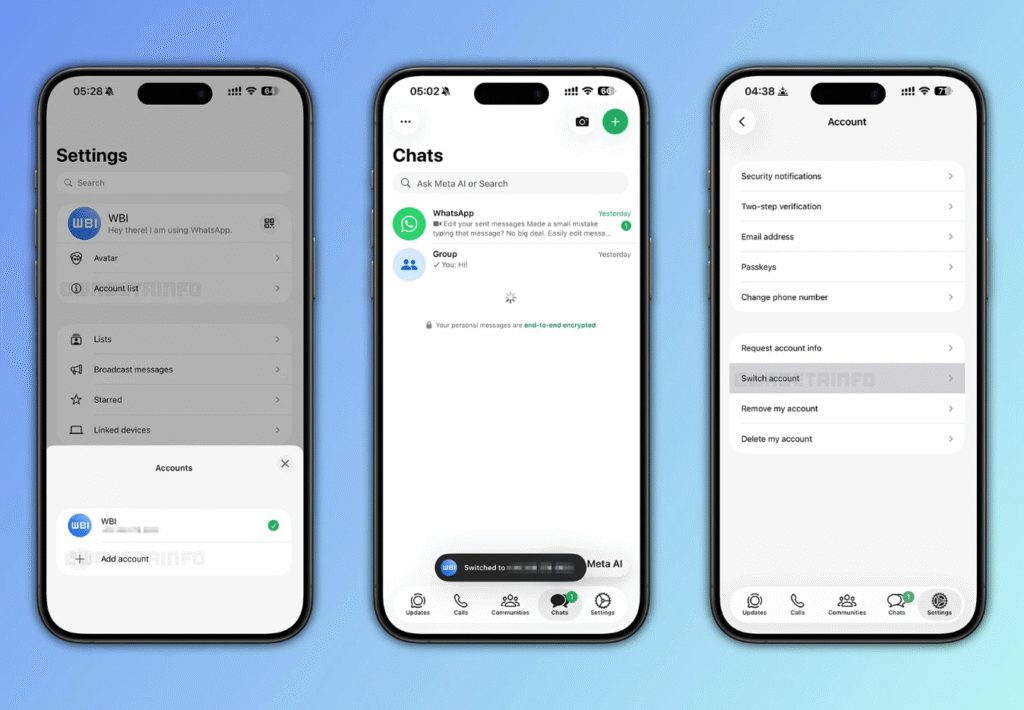
“Some beta testers can now add and switch between multiple accounts directly from the app’s settings menu.”
This is the strongest indication yet that Meta is finalizing the development of a multi-account feature designed to integrate seamlessly into WhatsApp’s existing interface. Early testers describe it as polished, stable, and clearly engineered with long-term usage in mind.
How WhatsApp’s Multi-Account System Works on iPhone
WhatsApp’s implementation focuses on simplicity, clarity, and organization ensuring that users can juggle conversations across accounts without confusion or technical complexity.
A New “Account List” Section in WhatsApp Settings
WhatsApp’s interface now includes a dedicated new panel called Account List, which acts as the hub for managing multiple accounts. Through this panel, users can:
Add accounts
Remove accounts
Switch between accounts instantly
View and configure account-specific settings
It can be accessed in two ways:
From WhatsApp’s Settings page
Via a new shortcut button beside the QR code icon
This design mirrors the multi-account support users already enjoy on other Meta platforms like Instagram and Facebook, creating a unified experience across apps.
WhatsApp Currently Supports Two Accounts on iPhone
In its beta phase, WhatsApp allows users to add up to two accounts per device. This limit may expand in the future, but even two accounts mark a major milestone, especially for:
Entrepreneurs managing customer inquiries
Professionals separating work and personal communication
Travelers juggling international numbers
Dual-SIM users tired of switching devices
Meta has designed multiple flexible methods for adding an account:
Ways to Add Additional WhatsApp Accounts on iPhone
1. Create a Brand-New WhatsApp Account
You can register a completely new phone number even one that has never been used on WhatsApp before.
2. Add an Existing WhatsApp Account
If you have an account previously used on:
WhatsApp Business
Another iPhone
An Android device
…you can add it instantly.
3. Link an Account Using Companion Mode (QR-Code Login)
Users who prefer WhatsApp’s multi-device ecosystem can add a companion account simply by scanning a QR code.
This method ensures:
Instant syncing
Complete mirroring of conversations
Transfer of settings and preferences
Secure authentication
Each WhatsApp Account Maintains Independent Settings
One of the most powerful aspects of WhatsApp’s multi-account support is that each account comes with its own unique environment. Nothing overlaps, and no data gets mixed. Every account keeps its own:
Chat history
Privacy preferences
Backup settings (iCloud independent for each account)
Notification tones
Custom wallpapers
Block lists
Two-factor authentication
Media auto-download preferences
This separation is especially beneficial for users who want a clear boundary between professional and personal spaces.
Clear Account Labels in iPhone Notifications
To avoid confusion when multiple WhatsApp accounts are active, WhatsApp has implemented account-specific notification labels. Each incoming alert will clearly display:
Which WhatsApp account received the message
The sender’s name or group name
The profile icon tied to that account
This is essential for accuracy, privacy, and productivity ensuring you never accidentally respond from the wrong account or mix up business and private chats.
Why WhatsApp Multi-Account Support Matters More Than Ever
With WhatsApp serving over 2 billion users, multi-account support addresses a global demand that has existed for years. iPhone users, in particular, faced major limitations due to Apple’s restrictions on cloning apps. This update dramatically changes that landscape.
1. Enhances Work-Life Balance
Users can finally maintain a clean separation between personal relationships and business obligations.
2. Boosts Productivity for Small-Business Owners
Entrepreneurs can:
Manage customer chats
Maintain support lines
Operate with a separate business number
…without needing WhatsApp Business.
3. Eliminates the Need for Multiple Apps
WhatsApp Business becomes optional rather than essential.
4. Ideal for Travelers
Tourists and expats who use international SIMs get seamless access to multiple WhatsApp identities.
5. Improves Device Efficiency
Managing two accounts in one app reduces:
Storage usage
Background data consumption
Battery drain
App switching fatigue
How Multi-Account Support Plays Into WhatsApp’s Future Vision
WhatsApp is evolving rapidly, moving beyond its original phone-number-centric design. Multi-account support fits into a larger ecosystem upgrade that includes:
1. Username Support (Coming Soon)
WhatsApp plans to let people connect using usernames instead of phone numbers.
2. Password-less Login Options
Meta is aligning WhatsApp with modern authentication standards.
3. Cross-Device Synchronization
WhatsApp’s multi-device support is getting more powerful and secure, allowing more devices per account.
4. End-to-End Encryption Enhancements
New privacy controls will improve security even with multiple accounts active.
These innovations show WhatsApp’s goal of becoming a more flexible, user-centric communication hub.
When Will WhatsApp Multi-Account Support Be Released?
While WhatsApp has not provided an official launch date, the feature appears nearly complete based on:
Stable performance in beta
Fully functional interface
Detailed account-specific controls
Widespread early access
Historically, WhatsApp’s beta features move into public release within weeks or a few months once they reach this level of refinement.
A full global rollout is expected soon, likely in an upcoming major update.
How to Prepare Your iPhone for WhatsApp Multi-Account Support
To ensure a smooth transition when the feature officially launches, users should take the following steps:
1. Update to the Latest Version of WhatsApp
Beta or stable—keeping the app updated ensures compatibility.
2. Install the Latest iOS Version
New features often require updated system frameworks.
3. Configure Dual SIM Settings
If you use two numbers, ensure both are active and properly configured.
4. Back Up Your WhatsApp Chats
Use iCloud for secure backup and restore options.
5. Join the WhatsApp TestFlight Program
If slots open, you can gain early access to new features before the public.
Final Thoughts: A Breakthrough Feature for iPhone Users
WhatsApp’s decision to bring multi-account support to the iPhone marks one of the platform’s most important updates of the last decade. For everyday users, professionals, business owners, and travelers, the ability to manage multiple WhatsApp identities within one app will dramatically improve convenience, privacy, and efficiency.
With unique account environments, clear notification labels, seamless switching, and secure syncing options, this feature lays the groundwork for a more advanced and customizable WhatsApp ecosystem. As Meta continues to modernize WhatsApp’s infrastructure, multi-account support is a major milestone one that brings iPhone users the flexibility they have been requesting for years.
WhatsApp is moving toward a future where managing digital identities across devices is effortless, secure, and intuitive and this update is a major step in that direction.
Remote work technology is evolving rapidly across industries worldwide. Companies are increasingly relying on innovative digital tools to stay connected, collaborate effectively, and maintain productivity from anywhere. As these technologies advance, they’re fundamentally transforming how teams work together in the modern digital workplace.
Artificial intelligence (AI) is revolutionizing remote work in many ways. Intelligent assistants now help with scheduling, summarizing meetings, and automating repetitive tasks, freeing up employees to focus on strategic and creative work.
AI powered collaboration tools analyze productivity patterns and workflow trends, offering valuable insights to help teams optimize their processes. Additionally, smart chatbots provide instant support for common technical issues, minimizing downtime and keeping daily operations running smoothly.
Machine learning also streamlines remote hiring by quickly screening candidates and predicting team compatibility. These tools enable organizations to build stronger, more efficient distributed teams.
Cloud Collaboration Platforms: The Heart of the Digital Office
Cloud based collaboration platforms are now the backbone of remote work environments. They allow teams to store files, manage projects, and communicate seamlessly all in one digital space. This means employees can access essential resources from any location, whether they’re at home, a coffee shop, or traveling.
Many cloud platforms combine features like messaging, document sharing, and task management, making teamwork more flexible and efficient. Real time editing further enhances collaboration by allowing multiple users to work on the same document simultaneously, boosting productivity.
Security remains a top priority, with encryption and advanced authentication methods protecting sensitive data. These advancements give organizations confidence in using cloud technology for their remote operations.
Virtual Reality: Creating Immersive Remote Work Experiences
Virtual reality (VR) is opening up new possibilities for remote teams to interact in immersive digital environments. Employees can meet in virtual offices using avatars, making online meetings more engaging and collaborative.
VR spaces allow for dynamic brainstorming sessions with interactive whiteboards and shared virtual objects. Training programs benefit too, as employees can learn complex skills through realistic simulations.
While VR hardware is becoming more comfortable and affordable, many companies are experimenting with virtual headquarters to foster a sense of community and shared space, regardless of physical location. These advancements are making remote work more engaging and interactive.
Strengthening Security for Remote Teams
As remote work grows, so do cybersecurity challenges. Companies are investing in sophisticated security measures to protect their remote workforce. Multi layered authentication systems and endpoint protection tools help safeguard sensitive information.
Zero trust security models are gaining popularity, requiring all users and devices to verify their identity before accessing company systems. This method greatly lowers the chances of unauthorized access.
AI driven security monitoring tools analyze network activity in real time, alerting security teams to suspicious behavior immediately. This proactive defense helps organizations keep their data safe in an increasingly digital world.
5G: Enabling Faster, More Reliable Remote Connectivity
Fast and stable internet connections are essential for effective remote work. Thanks to the rollout of 5G networks worldwide, employees now experience higher speeds and lower latency, making video calls clearer and data transfers quicker.
This enhanced connectivity supports advanced tools like augmented reality, which require a strong internet to function smoothly. It also gives employees more flexibility, enabling them to work efficiently from different places such as home, cafes, or coworking spaces.
Automation and Smart Workflow Tools
Automation is transforming the way teams operate in the digital workspace. Smart workflow tools automatically assign tasks, track progress, and give managers clear insights into team performance.
Modern productivity platforms analyze workloads and suggest optimal schedules for deep work sessions, helping employees stay organized and efficient. Automation also reduces time spent on manual administrative tasks, freeing up your team to focus on innovation and strategic initiatives.
Improving the Remote Employee Experience
Companies are increasingly using digital employee experience platforms that combine communication, HR services, and learning resources into a single interface. This simplifies access to essential tools and supports employee engagement.
These platforms often include feedback and recognition features, helping managers monitor satisfaction levels and strengthen workplace culture despite physical distance. Integrated learning systems enable employees to upgrade their skills through online training, promoting continuous growth in a remote setting.
The Rise of Hybrid Work Models
Hybrid work models blending remote flexibility within office collaboration are becoming the new standard. Employees split their time between working from home and coming into the office, providing greater flexibility and work life balance.
Technology plays an important role in helping hybrid teams work smoothly and stay connected. Smart meeting systems ensure remote participants can engage equally with office colleagues, with features like automatic camera focus on active speakers. Digital platforms synchronize tasks across locations, making collaboration seamless regardless of where team members are based.
Embracing the Future of Digital Work
The landscape of remote work technology is set to continue evolving with innovations like AI, cloud platforms, virtual reality, and advanced cybersecurity. These tools are making remote teams more efficient, secure, and connected.
Forward thinking organizations that adopt these cutting edge solutions will gain a competitive edge, while employees benefit from increased flexibility, better collaboration, and enhanced productivity. The future workplace will be more intelligent, immersive, and resilient powered by the latest remote work technologies.
PDF files remain the standard format for professional and academic documentation. Reports, contracts, research papers, and policies frequently appear as PDFs.
However, reading large documents requires significant time and concentration. Important information often hides within hundreds of pages.
Therefore, AI-assisted PDF tools have become essential productivity solutions. These tools allow users to ask questions directly inside documents.
Instead of scrolling endlessly, users simply interact through natural language prompts. Consequently, answers appear instantly with relevant context from the document.
Professionals, students, analysts, and administrators benefit from this technology. Moreover, these tools simplify complex documents without requiring technical expertise.
The best AI PDF platforms combine conversational intelligence with reliable document referencing. Additionally, they integrate smoothly with common workflows.
Below are the leading AI-assisted PDF tools of 2026 for extracting insights and answers quickly.
Adobe Acrobat leads the market for AI-powered document interaction. The platform integrates conversational AI directly into its PDF environment.
Users can ask questions about any uploaded document instantly. Furthermore, the AI assistant highlights sections that support each answer.
The system also generates document summaries quickly. Consequently, professionals understand long reports without extensive reading.
Another advantage involves seamless workflow integration. Users can read, highlight, comment, and ask AI questions inside one interface.
Additionally, the platform preserves document formatting and structure. Therefore, information remains accurate and easy to verify.
However, advanced AI features require a subscription plan. Nevertheless, the tool remains ideal for everyday professional document analysis.
Overall, Adobe Acrobat balances reliability, accessibility, and conversational intelligence effectively.
Best AI PDF Tool for Academic and Research Analysis
ChatPDF
ChatPDF specializes in analyzing research papers and technical documents. The tool focuses entirely on conversational document interaction.
Users upload a PDF and immediately start asking questions. For example, students can request summaries of complex academic papers.
Furthermore, ChatPDF highlights passages supporting each response. This transparency improves trust in AI-generated answers.
Researchers benefit from fast extraction of key insights. Consequently, reviewing large academic materials becomes far more efficient.
The interface remains intentionally minimal. Therefore, users concentrate on conversation instead of complex navigation.
However, ChatPDF lacks advanced document management features. Additionally, it usually analyzes one document at a time.
Despite limitations, ChatPDF excels at understanding dense research materials quickly.
Best AI Tool for Cross-Document PDF Insights
Humata
Humata focuses on analyzing multiple PDFs simultaneously. This feature makes it powerful for comparative research tasks.
Users upload several documents and ask cross-document questions. Consequently, the AI identifies patterns across different files.
For example, analysts can compare research reports or policy documents instantly. Moreover, Humata provides citations from each source document.
These citations help verify the accuracy of extracted information. Therefore, users maintain confidence in AI-generated insights.
The platform emphasizes analysis instead of traditional editing features. As a result, annotation tools remain limited.
However, researchers working with large document collections find significant value here. Additionally, organizations use Humata for knowledge discovery across archives.
Overall, Humata performs best within research-heavy environments.
Best Lightweight AI Tool for Quick PDF Summaries
AskYourPDF
AskYourPDF provides simple conversational access to uploaded documents. The tool prioritizes speed and ease of use.
Users upload a file and immediately begin chatting with the content. Consequently, summaries appear within seconds.
The interface remains clean and straightforward. Therefore, beginners quickly understand how the system works.
Additionally, AskYourPDF answers simple factual questions effectively. For example, users can locate clauses or definitions instantly.
However, advanced document analysis features remain limited. Moreover, users cannot control document context deeply.
Despite these limitations, the tool performs well for fast document insights. Many users rely on it for quick summaries and brief reviews.
Thus, AskYourPDF suits professionals needing lightweight PDF intelligence.
Best AI PDF Tool for Design-Focused Workflows
Canva AI Document Tools
Canva integrates AI document insights into its visual design ecosystem. This approach benefits teams creating presentations or visual reports.
Users upload PDFs and generate AI summaries quickly. Afterwards, they convert insights into slides or visual layouts.
Consequently, content moves smoothly from document to presentation format. Marketing teams and educators frequently benefit from this workflow.
Additionally, Canva offers an intuitive interface familiar to many users. Therefore, learning the system requires minimal effort.
However, document analysis remains secondary to design features. Detailed text analysis therefore remains limited.
Nevertheless, Canva excels when visual communication accompanies document review.
Using Stylus Devices with AI PDF Tools
Many professionals combine AI analysis with manual review. Stylus accessories improve this workflow significantly.
For example, tablets allow users to annotate documents after AI summarization. This process strengthens understanding and collaboration.
Users first extract insights through conversational AI. Afterwards, they highlight or annotate key sections manually.
Stylus tools enable handwritten notes and precise highlighting. Consequently, human judgment complements automated insights.
This combination keeps AI analysis and human review balanced. Moreover, teams maintain control over final interpretations.
Frequently Asked Questions About AI PDF Tools
What questions work best with AI PDF tools?
These tools perform best with factual queries and summaries. They also locate specific sections quickly.
How do AI PDF tools differ from traditional search?
Traditional search relies on keywords only. Conversational AI understands intent and contextual meaning.
Are AI PDF tools safe for sensitive documents?
Security depends on each platform’s data policies. Therefore, organizations should review privacy practices carefully.
When should users choose a full PDF platform?
Full platforms work best for workflows involving editing, annotation, and document management.
Conclusion
AI-assisted PDF tools transform how people interact with complex documents. Instead of manual reading, users simply ask intelligent questions.
Consequently, professionals save time while gaining deeper insights. Moreover, these tools make dense information far more accessible.
Adobe Acrobat offers the most balanced everyday solution. Meanwhile, ChatPDF and Humata excel in research environments.
Ask Your PDF provides fast summaries, whereas Canva supports creative workflows. Therefore, users can choose tools based on their specific needs.
As conversational AI evolves, document analysis will continue improving. Ultimately, AI-powered PDFs will redefine knowledge discovery across industries.
Meta is expanding its AI driven content ecosystem by testing a dedicated app for its Vibes AI video feature. The company confirmed the development as part of its strategy to strengthen short-form AI content creation and compete in the growing AI powered social media space.
The Vibes feature, first introduced last year by Meta Platforms, Inc., allows users to generate short AI videos, customize visuals, and share content through social feeds. Until now, Vibes existed inside the Meta AI app, but the company is now testing a standalone version to improve user experience and engagement.
The new standalone Vibes app will function similarly to popular short video platforms like TikTok style feeds, but with one key difference: every video is AI generated.
Users can create videos from scratch or remix existing AI content. The editing tools allow users to add music, adjust visual styles, and enhance creative elements before sharing. Videos can be posted directly to the Vibes feed or shared across platforms such as Instagram and Facebook Stories and Reels.
Meta says users are increasingly using Vibes to create and share content with friends, reflecting social behavior patterns similar to traditional short video platforms.
Competing in the AI Video Market
The standalone Vibes app positions Meta as a stronger competitor in the AI video content race, especially against platforms like OpenAI, which launched its AI video platform Sora.
Meta believes a dedicated app will provide a more immersive environment for AI creators. Instead of mixing AI video tools inside a broader AI assistant platform, Vibes will offer a focused creative space for content discovery and sharing.
Monetization and Future AI Features
Meta is also exploring subscription based AI services across its platforms. The company plans to test freemium access for Vibes video creation, allowing users to create a limited number of videos for free while offering premium subscription features for advanced creation tools.
These tests align with Meta’s broader subscription experiments across Facebook, Instagram, and WhatsApp.
The Future of AI Content Creation
Meta says Vibes usage continues to grow since its launch, even without exact user statistics being disclosed. The company plans to expand features based on community feedback.
If successful, Vibes could become a major player in the AI powered social content market, transforming how users create, edit, and share video content using artificial intelligence.
































 Food5 months ago