
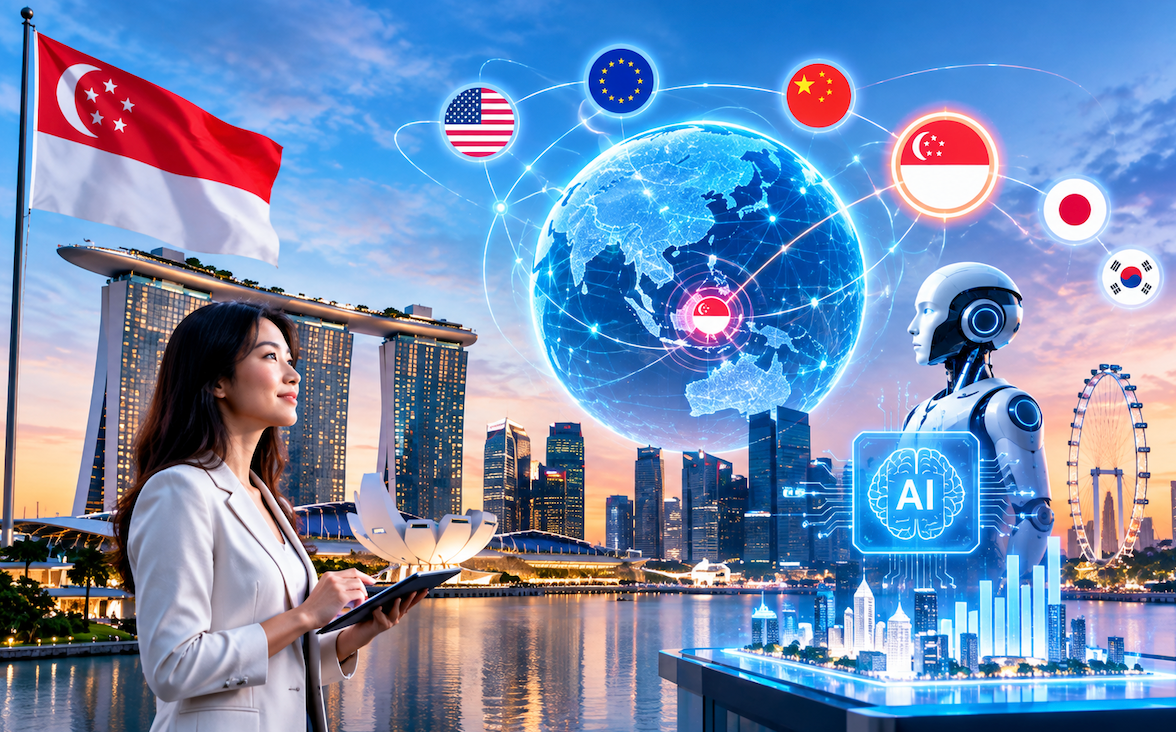
When Singapore unveiled its National AI Strategy 2.0 in late 2023, building on an initial strategy launched in 2019, the document set out ambitions to triple the country’s pool of AI practitioners and deepen investment in areas ranging from healthcare diagnostics to financial services fraud detection, backed by government funding commitments running into the billions of dollars across research grants, compute infrastructure, and talent programs.
For a country of roughly six million people competing against the United States, China, and the European Union for influence over how artificial intelligence develops globally, the strategy reflects a calculated bet on specialization rather than an attempt to match the raw scale of larger economies.
How Singapore’s National AI Strategy Is Structured
The strategy identifies specific priority domains where Singapore aims to build deep capability rather than spreading resources thinly across every possible AI application, including healthcare, financial services, supply chain and trade, smart cities and estates, education, and safety and security applications.
Government agencies including the Smart Nation and Digital Government Group, the Infocomm Media Development Authority, and AI Singapore, a national program coordinating research funding and talent development, work together to translate strategic priorities into funded programs, research grants, and industry partnerships.
A key structural feature is the emphasis on public-private collaboration, with government funding often structured to co-invest alongside private companies and research institutions rather than purely funding government-led initiatives in isolation. This approach aims to ensure that publicly funded AI research and infrastructure translates into commercially viable applications and local capability building rather than remaining confined to academic research that never reaches practical deployment.
The strategy also places emphasis on AI governance and trust infrastructure as a deliverable in its own right, not merely a compliance function layered on top of technical development. IMDA’s work on model testing toolkits and frameworks for evaluating AI system robustness reflects a view that trustworthy AI adoption, especially in regulated sectors like finance and healthcare, requires practical tools for verifying model behavior, not just high-level policy principles.
This focus on applied governance tooling distinguishes Singapore’s strategy from approaches that treat AI ethics primarily as a matter of published guidelines rather than technical infrastructure that developers and auditors can put to direct use.
Who Benefits from Singapore’s AI Investment
Local technology companies and startups gain access to funding programs, computing infrastructure, and talent pipelines that would otherwise be difficult for a small domestic market to sustain independently. Multinational technology companies, including major cloud providers and AI research labs, have established regional research and development operations in Singapore partly in response to government incentives and partly due to the country’s role as a regional headquarters location for Southeast Asian operations more broadly.
Workers across sectors touched by AI adoption, from financial services compliance roles being augmented by AI-driven fraud detection tools to healthcare professionals working alongside diagnostic AI systems in public hospitals, experience both opportunity and disruption as these technologies get deployed.
The government’s parallel investment in AI-related training through SkillsFuture and specialized programs aims to help the existing workforce adapt to these changes rather than leaving displacement risk unaddressed.
Public sector agencies themselves have become a notable adopter of AI applications, deploying chatbots for citizen services, predictive analytics for infrastructure maintenance planning, and automated processing tools for routine administrative tasks, positioning the government as both a regulator and an active practitioner of the technologies its strategy promotes.
This dual role gives Singapore’s policymakers direct, practical exposure to the operational challenges of AI deployment, including data quality issues and the difficulty of measuring productivity gains from automation, insights that feed back into how the broader national strategy is refined over successive iterations.
Economic and Business Implications
Singapore’s positioning as a regional AI hub has attracted data center investment, cloud infrastructure spending, and corporate research operations that contribute to gross domestic product beyond the direct economic activity of AI application development itself.
The government’s emphasis on becoming a trusted testbed for AI governance frameworks, including work on AI verification tools and model governance standards through IMDA, has also positioned Singapore as an attractive base for companies seeking to demonstrate responsible AI practices to global regulators and customers.
Financial services firms based in Singapore have been early adopters of AI applications in areas like fraud detection, credit risk assessment, and customer service automation, partly enabled by the Monetary Authority of Singapore’s regulatory sandbox approach that allows companies to trial AI applications under controlled conditions before full regulatory approval.
This has helped Singapore’s financial sector maintain competitiveness against larger financial centers by moving relatively quickly on practical AI deployment compared to jurisdictions with more cautious regulatory postures.
Healthcare has emerged as another sector where economic returns from AI adoption are becoming visible, with public hospitals deploying diagnostic support tools for radiology and pathology that help clinicians triage cases more efficiently, reducing bottlenecks in specialist review queues that had previously contributed to longer waiting times for certain diagnostic services.
Insurance companies operating in Singapore have similarly adopted AI-driven underwriting and claims processing tools, which industry participants describe as reducing processing times for routine claims from days to hours, freeing human staff to focus on more complex cases requiring judgment that current AI systems cannot reliably replicate.
Talent Development and Workforce Challenges
Singapore faces a persistent challenge in building sufficient domestic AI talent to match its ambitions, given the country’s small population relative to the scale of talent competition from the United States, China, and India.
The strategy’s target to triple the AI practitioner workforce relies heavily on a combination of local university program expansion, mid-career conversion programs funded partly through SkillsFuture mechanisms, and continued reliance on foreign talent through employment pass schemes tailored to specialized technology skills.
This dependence on foreign talent has created some political sensitivity, echoing broader debates in Singapore about the balance between attracting international expertise and ensuring adequate opportunities for local workers, a tension the government has tried to manage through targeted local talent development programs running alongside continued openness to skilled foreign AI researchers and engineers who are difficult to source domestically at the volume the strategy’s ambitions require.
Universities have expanded AI-focused degree programs and research centers substantially, with institutions such as the National University of Singapore and Nanyang Technological University building dedicated AI research institutes that collaborate closely with both government agencies and industry partners.
These academic investments aim to build a longer-term domestic talent pipeline that reduces reliance on foreign recruitment over time, though the multi-year lag between expanding university intake and producing job-ready graduates means the benefits of these investments will only become fully apparent well after the current strategy’s initial target milestones.
Criticism and Structural Limitations
Critics point out that Singapore’s small domestic market limits the scale of data available for training certain types of AI models compared to larger economies like the United States or China, where vastly larger user bases generate correspondingly larger datasets for training consumer-facing AI applications.
This structural limitation has pushed Singapore’s strategy toward specialization in areas like enterprise applications, financial services, and government services, where data scale requirements are more manageable, rather than attempting to compete directly in large-scale consumer AI model development.
Some technologists have also raised the question of dependency on foreign-developed foundation models, since Singapore’s enterprise and government AI applications largely build on top of large language models and other foundation models developed by companies based in the United States or China, rather than on domestically built base models.
This dependency means Singapore’s AI strategy, however well resourced, operates within technological constraints set largely by decisions made outside the country, a structural reality that has led some policymakers to advocate for at least partial investment in localized or fine-tuned models better suited to Southeast Asian languages and cultural context, an area where foundation models trained primarily on Western or Chinese-language data have historically underperformed.
Some technology policy analysts have also questioned whether government-directed strategic priorities risk missing emerging AI application areas that fall outside the officially designated priority domains, given how rapidly the underlying technology and its commercial applications continue to evolve.
There is a structural trade-off between the focus and resource concentration that comes from a targeted national strategy and the flexibility that a more organically evolving, market-driven approach to AI development might otherwise provide.
Comparing Singapore’s AI Strategy to Global Peers
Compared with the United States’ more market-driven, venture-capital-fueled AI development model, Singapore’s approach relies more heavily on coordinated government strategy and public funding, reflecting the country’s broader economic development tradition of active state involvement in shaping strategic industries.
China’s AI strategy shares some structural similarities in terms of government coordination and strategic prioritization but operates at a vastly larger scale given China’s population and domestic market size, making direct comparisons of ambition somewhat misleading despite superficial similarities in approach.
Within its own region, Singapore has positioned itself as a governance and regulatory thought leader on AI, publishing frameworks like the Model AI Governance Framework that other Southeast Asian nations have referenced in developing their own approaches.
This governance leadership role, distinct from raw AI research output, represents a deliberate strategic choice to compete on trust and regulatory clarity rather than attempting to out-innovate much larger economies on model development scale alone.
Future Outlook for Singapore’s AI Ambitions
Continued investment in compute infrastructure, including partnerships with cloud providers to expand data center capacity, will likely remain a priority given the computational demands of increasingly sophisticated AI models.
Expect further refinement of AI governance frameworks as international regulatory approaches, including the European Union’s AI Act and evolving United States federal and state-level AI regulations, continue to develop, since Singapore’s strategy of positioning itself as a trusted, well-regulated AI hub depends on staying credibly aligned with emerging international standards rather than drifting far from them.
Talent development will likely remain the most persistent structural challenge, and the effectiveness of mid-career conversion programs and continued openness to foreign AI talent will substantially determine whether Singapore can sustain its specialized application-focused strategy at the scale its ambitions require.
The next several years of strategy execution will offer a clearer picture of whether the targeted, specialization-focused approach delivers durable competitive advantage compared to more diffuse, market-driven national AI strategies pursued elsewhere.
Practical Guidance for Businesses and Workers
Businesses considering AI adoption in Singapore should explore government co-funding programs through AI Singapore and IMDA before assuming AI implementation costs must be fully self-funded, since substantial grant and pilot program support exists specifically to lower the barrier to enterprise AI adoption, notably for small and medium enterprises without large internal research budgets.
Companies in financial services or other regulated sectors should also investigate MAS’s regulatory sandbox mechanisms if planning to deploy AI applications that touch regulated financial activities.
Workers concerned about AI-related job displacement should look toward SkillsFuture-funded AI literacy and technical courses as a starting point, recognizing that roles requiring AI oversight, prompt engineering, or the ability to interpret and act on AI-generated outputs are likely to grow even in occupations where routine tasks face automation pressure.
Staying informed about which sectors the National AI Strategy identifies as priority domains can help workers and job seekers anticipate where demand for AI-adjacent skills is likely to concentrate over the coming years.
How Singapore’s Talent Pipeline Feeds Its AI Ambitions
A national AI strategy depends heavily on a steady pipeline of technically skilled graduates and mid-career professionals capable of building and deploying AI systems, and Singapore has approached this through a combination of expanded university intake in computing-related fields, targeted scholarships for AI and data science specializations, and conversion programs designed to help professionals from adjacent fields, such as statistics, engineering, and even the humanities, transition into AI-related roles.
Local universities have expanded their computing faculties over the past several years, adding new specializations in machine learning, robotics, and applied AI research, while polytechnics have introduced diploma programs aimed at producing a broader base of AI-literate technicians and support staff who can work alongside more specialized researchers and engineers.
Beyond formal education, the government has funded numerous short conversion programs specifically targeting mid-career professionals who want to pivot into AI-adjacent roles without returning to full-time study, recognizing that the pace of AI adoption across industries requires reskilling working adults rather than relying solely on new graduates to fill demand.
Whether this pipeline can keep pace with the rate at which AI is being embedded into everyday business operations, from customer service automation to financial risk modeling, will likely determine how much of the value created by AI adoption in Singapore is captured by local talent versus imported specialists.
Why International Research Partnerships Matter for Singapore’s AI Position
Given its comparatively small population and correspondingly smaller pool of AI researchers relative to countries like the United States or China, Singapore has leaned heavily on international research partnerships and welcoming policies for foreign AI talent and companies to punch above its weight in the field.
Local research institutes have established formal collaborations with major overseas universities and technology companies, allowing Singapore-based researchers to work on cutting-edge projects and publish alongside international collaborators rather than working in relative isolation.
The government has also actively courted global AI companies to establish regional research and development operations in Singapore, offering a combination of research grants, a stable regulatory environment, and access to a multilingual, digitally literate population as a testing ground for new AI applications before wider Southeast Asian rollout.
This strategy of positioning Singapore as a connector node within a global AI research network, rather than attempting to build every capability domestically, reflects a pragmatic acknowledgment that a small economy competing against much larger AI powers needs a different playbook focused on specialization, partnership, and being an attractive location for global talent and capital rather than pure scale.
Final Thoughts
Singapore’s AI strategy reflects a pragmatic recognition that a small nation cannot out-scale global technology powers, choosing instead to compete through targeted specialization, strong governance credentials, and close public-private coordination.
The approach has already attracted meaningful research investment and positioned Singapore as a regional reference point for AI governance frameworks.
Whether this specialization-focused strategy delivers lasting competitive advantage will depend heavily on how effectively the country closes its talent gap over the coming years, a challenge that remains very much unresolved.
What is clearer is that Singapore’s small size, once viewed as a constraint on its ability to compete in frontier technology, has instead become an asset in enabling faster policy coordination and pilot deployment than most larger economies can manage.
That agility, more than any single funding figure or talent target, may end up being the country’s most durable competitive edge in a field where the underlying technology itself continues to shift at a pace few national strategies fully anticipated when first drafted.
Frequently Asked Questions
1. What is Singapore’s National AI Strategy 2.0?
It is an updated national strategy launched in late 2023, building on an initial 2019 strategy, that sets ambitions around expanding Singapore’s AI talent pool, deepening AI adoption in priority sectors like healthcare and financial services, and strengthening the country’s compute infrastructure and governance frameworks.
2. Which sectors does Singapore prioritize for AI development?
Priority domains include healthcare, financial services, supply chain and trade, smart cities and estates, education, and safety and security applications, reflecting areas where Singapore believes it can build deep, competitive capability given its scale and existing economic strengths.
3. How does Singapore fund its AI initiatives?
Funding comes through government agencies including AI Singapore, IMDA, and various grant programs that often co-invest alongside private companies and research institutions, aiming to translate public investment into commercially viable applications rather than isolated academic research.
4. Can small businesses access government support for AI adoption?
Yes, various grant and pilot programs are available specifically to help small and medium enterprises adopt AI applications without bearing the full cost themselves, administered through agencies like IMDA and Enterprise Singapore in coordination with AI Singapore.
5. How does Singapore compete with larger economies like the United States and China in AI?
Singapore competes primarily through specialization in specific application domains, strong AI governance frameworks, and its role as a trusted regional hub, rather than attempting to match the raw scale of AI research and consumer data available to much larger economies.
6. What is the biggest challenge facing Singapore’s AI strategy?
Talent availability is widely seen as the most persistent challenge, given Singapore’s small population relative to global competition for AI researchers and engineers, which has made continued reliance on foreign talent alongside local training programs a central and sometimes politically sensitive feature of the strategy.